Vegetarian

Dinner for One with Bittman’s ‘Polenta without Fear’ + A Huge Thank You

polenta, chard and fried egg

I never thought the day would come when I would consider sautéed greens over polenta topped with a fried egg as the idea of the most delicious dinner. Well, the day is here (has been for a little while now), and I am so glad it is, because nothing could be simpler to prepare.

Before I write another word, however, I just want to extend a huge thank you to the reader who submitted my blog in the comments section of this Bitten post. I am so touched that you thought of me and am so shocked to have been selected. Thank you, too, to the Bitten bloggers for considering alexandra’s kitchen as a worthy under-the-radar blog.

I could think of no better way to commemorate this moment than by making one of my favorite Bittman recipes: Polenta without Fear, which recently appeared in the featured recipe section of Bitten. I first made this dish shortly after returning from a dinner party where, upon arrival, I had been charged with polenta-making duties. I went to work, but what I had hoped to produce to complement the host’s delectable braised short ribs left me embarrassed. (I must note that it didn’t help that the host didn’t own a whisk, but I can’t turn all the blame elsewhere.) My polenta was lumpy, dry and unflavorful. Why?!

Of course my mother had the answer. Or at least a solution. Have you made Bittman’s polenta recipe, she asked? No, I hadn’t. But I would soon, and I did. And it’s delicious. The recipe uses a ratio of 1 cup stone ground cornmeal to 3 cups of liquid (1 cup whole milk + 2 cups water) with the addition of 1/4 cup grated Parmigiano and 2 to 4 tablespoons of butter at the end. Minimal stirring is required and the addition of a little water towards the end of the cooking process is all the doctoring necessary to produce “creamy, soft, mouth-filling polenta,” as described on Bitten.

So, as the title suggests, this polenta, topped with some sautéed greens — chard, kale, spinach — and a fried egg makes a great dinner-for-one. Would I love some braised short ribs on my polenta? Of course, but there are better opportunities for that. Need another dinner-for-one idea? Try these Zuni Cafe Eggs Fried in Bread Crumbs … so yummy!

The ingredients:
mise en place for dinner for one

Sautéed onions and Swiss chard from my Morning Song Farm CSA:
Swiss chard and onions over polenta

polenta, chard and fried egg

Polenta without Fear

Source: Bitten
Serves: 4

1 cup milk (preferably whole milk)
Salt
1 cup coarse cornmeal, preferably stone-ground
Freshly ground black pepper, to taste
2 to 4 tablespoons butter or extra virgin olive oil
1/4 cup or more freshly grated Parmigiano-Reggiano, to taste, optional

1. Bring milk to a boil with 2 cups water in a medium saucepan and add a large pinch of salt. Adjust heat so liquid simmers. Add cornmeal in a steady stream, whisking as you do to prevent lumps. When it has all been added, let mixture return to a boil, then turn heat to low. Polenta should be just barely simmering.

2. Cook, stirring occasionally and being sure to scrape sides and bottom of pan, for 15 to 20 minutes, until mixture is creamy and cornmeal tastes cooked. If mixture becomes too thick, whisk in some water, about 1/2 cup at a time. (I added about 2/3 cup water in 1/3 cup increments.)

3. Taste and season polenta as necessary with salt and pepper. Take pan off stove, stir in the butter or oil and the cheese if you are using it, and serve, passing more cheese at the table if you like.

Serve with sautéed greens and a fried egg for a simple simple dinner.

Tomato, Corn & Cheese Galette — A Favorite Summer Meal — With A Chocolate Chip Cookie for Dessert

tomato tart

The August 2000 issue of Fine Cooking Magazine was fantastic. I can’t believe that two of my all-time favorite recipes came from that issue — from one article in fact — and that I have now been making these recipes for almost 10 years. I feel old.

I didn’t realize it at the time, but David Lebovitz, author of The Perfect Scoop, wrote the article and supplied the two fabulous tart dough recipes, one sweet, one savory, that I have been making all these years. The sweet galette dough is used in this recipe as well as this one (both from the above mentioned article), and the savory cornmeal galette dough is used in the above pictured tart, and it is so tasty.

This galette, filled with caramelized onions, fresh corn, basil, Gruyère cheese and heirloom tomatoes, is prefect for the end of summer. Serve it with a simple mixed greens salad or a cucumber-and-feta cheese plate for a light, vegetarian meal. Yum.

I have actually blogged about this tart before. In that post, however, I had pressed the dough into a tart shell and blind baked it briefly before adding the remaining ingredients. That method is fine, just a touch fussier. I prefer making these rustic, free-form tarts.

 tomato tart

The original recipe for this tart calls for onions as opposed to leeks. I used leeks because I received a whole bunch in my CSA, but truthfully, I think this tart is tastier with onions. Use whatever you have. Gruyère is particularly tasty, but any cheese you have on hand will do.

tart ingredients

Assembling these tarts is easy: Simply spread the corn and caramelized onion (or leek) mixture into the center of the dough; top with cheese; top with the tomatoes; then fold the edges up to make a free-form tart.

Assembling the Tart

Tomato, Corn and Cheese Galette with Fresh Basil

Source: Fine Cooking Magazine (40, pp. 68-73 August 2000)
Serves 4

Note: For no particular reason, I split the dough in half and made two small tarts, but this is unnecessary. Normally I make just one large tart, and it is fantastic.

Cornmeal Galette Dough

1-1/4 cups (5 oz.) all-purpose flour
1/3 cup (1-1/2 oz.) fine yellow cornmeal
1 tsp. sugar
1-1/4 tsp. salt
6 T. (3 oz.) unsalted butter, cut into 1/2-inch pieces and chilled
3 T. olive oil
1/4 cup ice water

In a medium bowl, mix together the flour, cornmeal, sugar, and salt. Cut in the chilled butter using a stand mixer, a food processor, or a pastry blender until it’s evenly distributed but still in large, visible pieces. Add the olive oil and ice water and mix until the dough begins to come together. Gather the dough with your hands and shape it into a disk. Wrap the disk in plastic and refrigerate for at least 1 hour.

Finishing the tart:

2 Tbs. olive oil
1 large white onion, thinly sliced
Salt and freshly ground black pepper
2 cloves garlic, chopped finely
1/2 bunch basil or tarragon, washed, dried, and coarsely chopped, (to yield about 1/2 cup); plus 10 whole leaves
Kernels from 1 ear of corn (about 1 cup)
1 recipe Cornmeal Galette Dough (see above)
1 large or 2 medium ripe tomatoes (about 3/4 lb. total) cut into 1/3-inch slices, drained on paper towels
3 oz. Comté or Gruyère cheese, shredded
1 large egg yolk mixed with 1 tsp. milk or cream

1. Heat the olive oil in a sauté pan, preferably nonstick, over medium heat. Add the sliced onion and cook, stirring frequently, until lightly browned, about 10 min. Season with salt and pepper. Add the garlic, chopped basil, and corn and cook for 30 seconds. Transfer the mixture to a bowl and set aside to cool.

2. Adjust an oven rack to the center position and heat the oven to 375°F. Line a baking sheet, preferably one without sides, with kitchen parchment. (If your baking sheet has sides, flip it over and use the back.)

3. Roll the dough on a floured surface into a 15-inch round, lifting the dough with a metal spatula as you roll to make sure it’s not sticking. If it is, dust the surface with more flour. Transfer it by rolling it around the rolling pin and unrolling it on the lined baking sheet.

4. Spread the onion and corn mixture over the dough, leaving a 2-inch border without filling. Arrange the tomatoes in a single layer over the onions and season them with salt and pepper. Sprinkle the cheese over the tomatoes. Lift the edges of the dough and fold them inward over the filling, pleating as you go, to form a folded-over border. Pinch together any tears in the dough. Brush the egg yolk and milk mixture over the exposed crust.

5. Bake until the crust has browned and the cheese has melted, 35 to 45 min. Slide the galette off the parchment and onto a cooling rack. Let cool for 10 min. Stack the remaining 10 basil leaves and use a sharp knife to cut them into a chiffonade. Cut the galette into wedges, sprinkle with the basil, and serve.

tomato tart

This is another recipe I’ve already blogged about, but it is so good. Chewy Chocolate Chip Cookies. The key is to keep your oven at 375ºF; bake only 6 cookies on a sheet at one time; and remove them from the oven after 11 minutes — they won’t look done but they continue cooking on the sheet. For kicks, I added a little fleur de sel to the tops of these before baking. Here’s the recipe.

chewy chocolate chip cookie with a touch of salt on top

In Honor of Top Chef: Padma’s Salad with Rancho Gordo Beans & Bäco Flatbreads

Padma's Salad
Early last Wednesday morning, before the premier of Top Chef Las Vegas, Padma Lakshmi made a delectable looking salad on the Today Show with Matt Lauer. She chopped up fresh spinach, mixed it with chickpeas, bell peppers and chives, and tossed it all together with olive oil and lemon juice. Served with fresh pita bread, says Padma, this “chickpea tapas” makes a wonderful whole meal.

I couldn’t agree more. Upon seeing this segment, I felt inspired to cook up some of the Ranch Gordo beans I had picked up in San Francisco earlier this month. I have been wanting to incorporate more beans — such a healthy, affordable food, filled with protein — into my diet, and this salad has proven to be a great way to do so. I made this salad two nights in a row last week with my Alubia Criollo beans and various other goodies from my CSA — arugula, cherry tomatoes, chives, shaved zucchini and chopped orange.

Beans, I am learning, are really not so much trouble to make from scratch. I soaked mine in the morning and cooked them according to the instructions on the Rancho Gordo website. I’m not a bean connoisseur, but I like RG’s description of these small white beans: Alubios have a “rich, buttery flavor and creamy, over-the-moon texture.”

I ate my salad with these Bäco flatbreads, the recipe for which I spotted in the LA Times in June 2008 and have had tacked to my fridge ever since. Bäco flatbreads, made with Greek yogurt seasoned with ginger, garlic and lime juice, are similar to the pita breads used for gyros — the pocketless pita breads. They are delicious! The recipe yields more yogurt sauce than needed, but the sauce makes a nice accompaniment to both the flatbreads and the salad. A nice little combination eaten taco style is a bäco flatbread, spread with some yogurt sauce and topped with some salad. So yummy!

Note: I omitted the lavendar and added some chives.

Bacao Flatbread

Bacao cooking in pan

salad ingredients

Here is Padma’s basic recipe. Please note, however, that Padma prefers making this with raw spinach or arugula — I used raw, chopped arugula — as opposed to cooked, which is what her recipe says to do. Also, any vegetables — tomatoes, zucchini, corn, mushrooms, etc. — can be added to this salad. A nice variety of vegetables makes for a nice variety of flavors and textures. I also used a little balsamic vinegar in addition to the fresh lemon juice.

Here is the Bäco Flatbreads recipe. I added some chives to the yogurt mixture and served some of the remaining yogurt sauce with the flatbread and the salad — this is such a yummy meal!

Tartine’s Quiche, Homemade Crème Fraîche & A Little Trip to Napa & Bouchon

Tartine Quiche

The weekend would begin with quiche. That was a given. My friend would pick me up at the San Francisco airport and before beginning our journey north, we would stop for breakfast. For quiche, that is. I have been dreaming about the Tartine quiche for over a year now, since my last and only other visit to this most adored San Francisco cafe.

The much anticipated weekend arrived, and I found myself at Tartine with two dear friends standing in a line stretching around the corner. As we waited, we contemplated our order, which quickly became apparent would be a feast. None of us was prepared to make a difficult decision this morning, so we decided to keep things simple — we would order everything. Or nearly everything: Quiche. Croque monsieur. Morning Bun. Scone. Croissant. Almond Croissant. Bread Pudding.

The quiche with ham and Swiss chard, my friends confirmed, lived up to every expectation I had created for them. The bread pudding with fresh peaches, too, and the croque monsieur with heirloom tomatoes and Gruyère similarly blew us away. It’s rare for a restaurant to offer an across-the-board spread of so many delectables, but it seems that’s just how Tartine rolls. 

So, what separates Tartine’s quiche from others? Well, I have a few ideas, thanks to the Tartine cookbook, which so generously has provided a dead-on recipe. Seriously. I followed the recipe to a T and recreated, what I believe, is the most delicious quiche on the planet. 

1. The custard ingredients/ratio. I suspect this is the primary reason why Tartine’s quiche is so fabulous. Tartine uses a ratio of 1 cup crème fraîche to 1 cup whole milk to 5 eggs. The mixing method is also interesting — one egg is whisked with 3 T. of flour until smooth. Then the remaining eggs are whisked in. Then the egg mixture is strained over the crème fraîche-milk mixture. Sound fussy? Well, it sort of is. But it’s so worth it. I wouldn’t recommend straying from the recipe or taking any shortcuts in any way.

When I made this at home, I, for the first time ever, made my own crème fraîche, which was so much fun — it’s crazy  to see heavy cream transform into a thick, tangy mass of goodness. Making crème fraîche is easy: Mix 2 tablespoons of buttermilk (or 2 tablespoons of yogurt) with 2 cups of heavy cream. Cover the bowl with plastic wrap and let sit at room temperature for 12 to 24 hours. Stir and then store until ready to use. It’s magic! 

2. The flaky tart shell is delectable. There is nothing unusual about the Tartine recipe — flour, salt, ice water and lots of cold butter. Blindbaking the shell for about 30 minutes ensures a crisp, perfectly browned crust.

3. Tartine uses uncooked greens. For whatever reason, I have been in the habit of quickly sauteéing any type of green before adding it to a quiche, but Tartine recommends otherwise. The recipe calls for 1 cup of uncooked roughly chopped greens. This is the only step where I strayed a tad — I added more like 2-3 cups of roughly chopped Swiss chard.

Well, that about concludes my Tartine quiche analysis. I feel silly getting spiritual about something as basic as a quiche, but the Tartine quiche has completely changed my perception of this classic dish. The texture of the Tartine quiche, which has not an ounce of cheese, is truly a beautiful beautiful thing. Quiche, for me, prior to tasting Tartine’s, was all about the fillers — onions, bacon, cheese, zucchini, tomatoes, mushrooms, whatever. Now, it’s about the custard, the light, creamy, custard. 

I must admit that making this quiche is no simple task. That said, if you have the tart dough made in advance (which I do now since the tart dough recipe yields enough for two 10-inch quiches) and if you have the crème fraîche made in advance (or are using store bought), making this quiche isn’t such a process. It’s also just a matter of getting familiar with the process. 

Tartine Quiche

Clockwise from top left: Quiche shell, lined with parchment paper, ready to be blind-baked. Filled quiche shell ready for the oven. Baked quiche. Baked quiche up close. 

Quiche

Next on my recipes to tackle in the Tartine cookbook is bread pudding made with homemade brioche bread. Before we head there, however, I just want to share a few highlights of my trip to Napa:

Wine tasting at Cakebread Cellars in Napa Valley. Grapes at Cakebread:

Grapes

Wine tasting at Hendry’s Winery in Napa. The tasting table at Hendry’s:

Tasting Table at Hendry's Vineyard

Eating macaroons at Bouchon in Yountville. Incredibly delicious.

Bouchon Macarons

Visiting Bouchon altogher. Here we sampled TKOs (Thomas Keller Oreos), chocolate bouchons, macaroons, croissants, almond croissants, ham and cheese sandwiches, epi baguettes and quiche. The spread, pictured at the very bottom, was remarkable. 

Bouchon

Quiche with Crème Fraîche and Swiss Chard
Source: Tartine (Chronicle Books, 2006)
Serves 6 to 8

Flaky Tart Dough
Yield = 2 10-inch tart or pie shells

1 tsp. salt (I used table salt)
2/3 cup ice water
3 cups + 2 T. all-purpose flour (1 lb.)
1 cup + 5 T. unsalted butter, very cold

1. In a small bowl, add the salt to the water and stir to dissolve. Keep cold until ready to use.

2. Place the flour in a large mixing bowl. Cut the butter into 1-inch (or smaller) pieces and scatter the pieces over the flour. Using a pastry blender or two knives or two forks, cut the butter into the flour until the mixture forms large clumps and the butter is in pieces the size of small peas. Drizzle the water-salt mixture over the flour and stir and toss with a fork until the dough comes together in a shaggy mass. Gently mix until the dough comes together into a ball but is not completely smooth.

3. On a lightly floured work surface, divide the dough into 2 equal balls and shape each ball into a disk 1-inch thick. Wrap well in plastic wrap and chill for at least 2 hours or up to overnight.

4. Preheat the oven to 375ºF.

5. Place dough on a lightly floured surface and roll out to 1/8-inch thick, rolling from the center toward the edge in all directions. (Lift and rotate the dough a quarter turn every few strokes to prevent sticking, and work quickly to prevent the dough from becoming warm.) Transfer the round to the pie dish, easing it into the corners. Trim excess dough.

6. Cut a piece of parchment paper large enough to fit over the pie plate generously. Fill parchment paper with pie weights or dried beans. Bake for about 25 minutes or until the surface looks light brown. Remove from oven and remove the weights and paper. Return the shell to the oven and bake until golden brown, about 5 minutes longer. Cool shell on wire rack until ready to fill.

Quiche with Swiss Chard and Crème Fraîche

1 fully baked 10-inch Flaky Tart Shell Dough (recipe above)
5 large eggs
3 T. all-purpose flour
1 cup crème fraîche*
1 cup whole milk
1 tsp. kosher salt
½ tsp. freshly ground black pepper
1 T. fresh thyme, finely chopped (I didn’t have thyme so I used chives)
1 cup uncooked coarsely chopped Swiss Chard (I used more like 2 or 3 cups)

1. Preheat the oven to 375ºF.

2. Place 1 egg and the flour in a large bowl and whisk until smooth. Whisk in the remaining 4 eggs until blended.

3. In a medium bowl, whisk the crème fraîche until smooth. Whisk in the milk. Pour the egg mixture through a fine mesh sieve held over the milk mixture. Whisk in the salt, pepper and thyme (or other herb). Stir in the chard.

4. Pour the egg mixture into the pastry shell. Place in the oven and bake for 10 minutes. Reduce the oven temperature to 325ºF and bake until the filling is just set, about 30 minutes longer. The center of the quiche should still feel slightly firm, rather than liquidy, when touched. Let cool on a wire rack for at least 20 minutes to allow the custard to set up, so that it will slice neatly. It can be served warm or at room temperature. To serve a fully cooled quiche warm, cover it with aluminum foil and reheat it in a 325ºF for about 15 minutes.

* To make crème fraîche, place 2 cups heavy cream in bowl. Add 2 tablespoons of yogurt or 2 tablespoons of buttermilk. Stir to combine. Cover bowl with plastic wrap and let sit at room temperature for 12 to 24 hours. Stir. Mixture will be nice and thick. Store in the fridge until ready to use.

Bouchon Spread

Carrot Cake & Soup, Anniversary Dinner at Izza

carrot cake

Last week I found a stockpile of carrots in the bottom left-hand drawer of my fridge. So, I set to work slicing and dicing, staining my cutting board, dulling my knife, tearing up my uncalloused little hands. Sike. I did nothing of the sort. I for once used my little brain and pulled out an attachment to my Cuisinart I have yet to use. Magic. In about 30 seconds, this gadget had transformed my pound of carrots into perfect little shreds. I didn’t even peel these guys. Just gave them a good scrub, and sent them down the shoot. 

With prep work done, I set to work on a carrot cake recipe I have had saved for years. It appeared in Fine Cooking magazine in 2004 in an article called “Carrot Cake, Perfected.” Why I have waited five years to give the recipe a go is beyond me, but I am so happy I finally have. This recipe is a winner.

With the rest of my carrots, I made a yummy gingered-carrot soup roughly based off The New Moosewood Cookbook’s recipe. And I promise to supply this recipe once I actually make it properly. For whatever reason, I left out about five ingredients, substituted five others, and produced something resembling nothing close to what Mollie Katzen had prescribed. Fortunately, I have another bundle of carrots to play with this week.

carrotswholeandshredded

With the above-pictured carrots, I made cake.

With the below-pictured carrots, I made soup. Some were a tad wrinkly, sure. Not to worry, once puréed, no one would suspect a thing.

carrots

Below: Carrot-ginger soup served with Bäco flatbreads. These deserve their own post. Soon, I hope.

carrot-ginger soup

ginger & garlic

Mini spring-form pans filled with batter (at left) and baked (at right).

baked & unbaked cakes

cut cakes

carrot cakes

cake

cake

I made several mini cakes with this batter as well as some patriotic cupcakes for the Fouth of July. While the cupcakes were a hit, this batter definitely bakes more evenly and better in cake pans. Stick to cakes with this recipe. It is a yummy yummy recipe. 

frosted cupcakes

The pizza guys at Izza, a new San Clemente pizza joint.
pizza guys

I’m not sure why I’m trying to squeeze so much into this post, but I just want to tell you one more thing. This past Wednesday, the love of my life and I celebrated our four-year anniversary by eating our favorite food on the planet … pizza pizza. Izza, a thin-crust, wood-fired, Neopolitan-style pizza place opened its doors just in time for us to celebrate our happy day. The pizza was fabulous, our server was adorable, and the vanilla gelato was heavenly. We couldn’t be happier with this addition to the San Clemente restaurant scene. Well, if they added a white clam pizza to their menu, I might be slightly happier, but maybe in time that will come.

And last but not least, check out this old photo I found. It was taken way back in middle school when Ben and I met on a field trip in Thessaloniki. I’m just kidding, you know, but seriously, I would have guessed ages 15 and 12 respectively. Yikes.

ben & ali

The Ultimate Carrot Cake
Source: Fine Cooking Magazine
Article: “Carrot Cake, Perfected” by Gregory Case

Note: I have made some modifications to the original recipe. To read the original, click here.

For the cake:
Softened butter and flour for the pan
1 lb. carrots
10 oz. (2-1/4 cups) all-purpose flour
2 tsp. baking soda
1 tsp. table salt
1 tsp. ground cinnamon
4 large eggs, at room temperature
1-1/2 cups granulated sugar
1/2 cup packed dark brown sugar
1 1/4 cup vegetable oil

For the frosting:
8 oz. (1 cup) unsalted butter, cut into 1/2-inch pieces and completely softened at room temperature
1 lb. cream cheese, cut into pieces and completely softened at room temperature
4-1/4 oz. (1 cup) confectioners’ sugar, sifted
1 Tbs. pure vanilla extract

Make the cake:
1. Position a rack in the bottom third of the oven and heat the oven to 350°F. Butter and flour a 9×13-inch heavy-duty metal cake pan.

2. In a food processor, using the shredder attachment, shred the carrots. Transfer to a small bowl and rinse the food processor bowl (you’ll need it again).

3. In a large bowl, combine the flour, baking soda, salt and cinnamon. Whisk to blend thoroughly.

4. In the food processor (again use the steel blade), mix the eggs and sugars until blended. With the machine running, slowly add the oil in a steady stream until combined. Scrape this mixture into the flour mixture. Stir with a wooden spoon or rubber spatula to combine. Add the carrots; stir to combine.

5. Scrape the batter into the prepared pan. Bake until a toothpick inserted in the center of the cake comes out clean, about 50 minutes. Let cool on a rack to room temperature before inverting the pan to remove the cake. Let cool completely before frosting.

Make the frosting:
Fit a stand mixer with the paddle attachment (a hand mixer works, too). Beat the butter on medium speed until it’s quite light, fluffy, and resembles whipped cream, about 3 minutes. Add the cream cheese one piece at a time, beating well after each addition. When all the cream cheese is incorporated, reduce the speed to medium low and gradually add the sugar and vanilla, stopping the mixer each time you add the sugar. Mix just enough to remove any lumps; scrape the bowl as needed. If the frosting seems a bit loose, refrigerate it for a few minutes until it seems spreadable.

Frost the cake:
Scrape about two-thirds of the frosting onto the center of the cake. With a narrow metal offset spatula, push the frosting from the center out to and just over the cake’s edges. Spread with as few strokes as possible to prevent crumbs from catching in the frosting. Cover the top of the cake first then use the remaining frosting along with what’s creeping over the edges of the cake to cover the sides.

Alice Waters’ Baked Goat Cheese Salad & Morning Song Farm CSA

salad3

It’s hard to find fault in a warm round of herb-marinated, breadcrumb-encrusted goat cheese. But seriously my friends, the goat cheese was not the star of this salad. See those greens up there? The tender green leaves and the baby red romaine? These greens, gosh, I can’t even begin to tell you how delicious they are. They come from Morning Song Farm, the north San Diego County farm whose CSA I just joined.

I have been meaning to join a CSA since arriving in California over a year ago now, and when I learned that the new wine and cheese bar in town was a drop off spot for CSAs, I jumped. I signed up on a Monday via email and two days later my box of freshly harvested produce arrived at The Cellar. I can’t tell you how easy it was. Before I knew it, the above pictured greens were in my hands along with a boodle of other treats — lemons, avocados, grapefruits, Swiss Chard, beets, strawberries, herbs and the list goes on and on. (You can see almost everything that arrived in weeks one and two in the pictures below.)

Most of you know what a CSA is, but just in case, there is a quick summary about halfway down the page here. And if you still haven’t signed up for one, check out LocalHarvest.org. With 2,500 participating farms listed in their database, Local Harvest has the most comprehensive directory of CSAs in the country.

When I saw these greens, I thought of Alice Waters’ recipe for baked goat cheese salad, which Cookstr recently highlighted in their Mother’s Day newsletter. It’s a wonderful recipe. I followed it mostly, substituting toasted panko bread crumbs for the freshly made ones, a shortcut I’m sure Alice Waters would look down on, but alas, it worked.

Anyway, hooray!, it’s Wednesday, which means it’s CSA pickup day. I hate to be sentimental, but one of the best parts about belonging to a CSA is actually belonging. I so look forward to walking up to The Cellar every Wednesday and saying hi to Dawn and Zoe, who have become my west coast incarnations of Sarah Cain, Emily Teel and Joanna Pernick, my friends at the Fair Food Farmstand whom I dearly miss. It is so much fun peaking inside the box each week, inspecting the goods, and sharing a strawberry or a few strands of the most fragrant and delectable mint you have ever seen. Seriously, it is a real joy.

csa3

csa1

week2_csa

csa week 2

Red Lettuce

lettuce

babygreens

Baked Goat Cheese Salad
Source: Alice Water’s and Cookstr
Serves: 4

For the goat cheese rounds:
½ pound fresh goat cheese (one 2 by 5-inch log)
1 cup extra virgin olive oil
3 to 4 sprigs fresh thyme, chopped
1 small sprig rosemary, chopped
½ sour baguette, preferably a day old (I used panko bread crumbs)

For the salad:
1 tablespoon red wine vinegar
1 teaspoon sherry vinegar
Salt and pepper
¼ cup extra virgin olive oil, walnut oil, or a combination
½ pound garden lettuces, washed and dried

1. Carefully slice the goat cheese into 8 disks about ½ inch thick. Pour the olive oil over the disks and sprinkle with the chopped herbs. Cover and store in a cool place for several hours or up to a week.

2. Preheat the oven to 300°F. Cut the baguette in half lengthwise and dry out in the oven for 20 minutes or so, until dry and lightly colored. Grate into fine crumbs on a box grater or in a food processor. The crumbs can be made in advance and stored until needed. (Note: Using panko makes this process much simpler)

3. Preheat the oven to 400°F. (Note: Cookstr says a toaster oven works well.) Remove the cheese disks from the marinade and roll them in the bread crumbs, coating them thoroughly. Place the cheeses on a small baking sheet and bake for about 6 minutes, until the cheese is warm.

4. Measure the vinegars into a small bowl and add a big pinch of salt. Whisk in the oil and a little freshly ground pepper. Taste for seasoning and adjust. Toss the lettuces lightly with the vinaigrette and arrange on salad plates. With a metal spatula, carefully place 2 disks of the baked cheese on each plate and serve.

Gordon Hamersley’s Beet, Goat Cheese and Walnut Tart

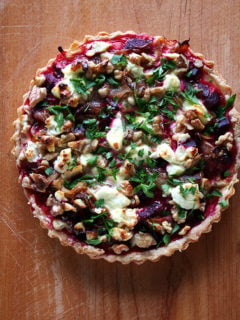
baked tart

This tart is really fun. And different. And delicious. I can’t promise a quick-and-easy dinner with this recipe — beets must be roasted; a tart shell must be baked — but with a little planning, assembly of this tart is quite simple. And it is so worth the effort.

Why are beets, goat cheese and walnuts so good together? And why did I never think to bake them all together in a flaky, buttery shell? Gordon Hamersley recommends serving this tart with a little mixed greens tossed with a bright vinaigrette, which is exactly what I did.

I spotted this recipe in a recent Cookstr newsletter entitled “10 Dishes Under $10.” Under $10 very likely it was — my bunch of beets cost $2 at the farmers’ market, and I still have all of the greens remaining to use for another meal. 

Let’s see. I did make a few changes, only one of which is significant. I substituted buttermilk for the heavy cream. The recipe calls for 3/4 of a cup of heavy cream, which, and I hate to be so girly, amounts to 700 calories. The substitution of buttermilk brings that down to 90. Nine. Zero. I mean that is seriously significant. And while I can’t speak for the taste of the full-fat version, buttermilk does not compromise the flavor. This tart is fabulous. I ate leftovers for breakfast and dinner. Yum yum yum.

The other changes are minor and noted in the recipe.

beets

Above: Beets purchased from the San Clemente Farmers’ Market. I like to buy my beets from Eli’s Ranch. (They park in front of the library and sell the best avocados, too.)

Below: To blind bake a tart shell, line it with plastic wrap and dried beans. Fold the plastic up and over so that the crust is exposed. Bake for about 20 minutes at 375ºF.

preparing to blind bake the tart shell

unbaked tart

baked tart

Be warned: If you care about your cutting board, don’t cut beets on it. I forgot to use my plastic one for this job. Oops. 

beet board

Beet, Goat Cheese and Walnut Tart

Source: Gordon Hamersley via Cookstr
Note: Below is a simplified version of the recipe. Find the original here.
Serves 4 to 6

1 recipe tart dough, shaped and blind baked
Yield: 12 ounces, enough for one 10-inch tart or 6 individual tarts

1½ cups all-purpose flour
½ teaspoon kosher salt
10 tablespoons unsalted butter, cut into small cubes and well chilled
4 to 5 tablespoons ice water

1. In a mixing bowl, combine the flour and the salt. Quickly cut the butter into the flour, using a pastry blender or the back of a fork, until the butter pieces are the size of large peas. (Alternatively, cut the butter into the flour by pulsing it 8 to 10 times in a food processor, being careful not to overheat and overmix the butter.)

2. Add the ice water. Using just your fingertips and working quickly, combine the flour mixture and the water. Work just until the water is absorbed. The dough will be ragged but should hold together when you squeeze it. If it seems dry, sprinkle on a few more drops of water. (I had to add a few more tablespoons of water.)

3. Gather the dough up into a ball — it’s fine if the dough does not come together completely at this time. Wrap the dough well in plastic wrap, flatten it a bit, and let it rest in the refrigerator for at least a half hour before rolling. The dough will keep in the refrigerator for up to 2 days. You can also freeze the dough, well wrapped; allow it to defrost for a day in the refrigerator before using it.

4. Preheat the oven to 375ºF. Roll the dough into a large circle — large enough to overlap whatever sized tart pan you are using. Press the dough into the corners and into the sides of the tart pan. Trim off any excess dough. Line the tart with plastic wrap and fill with dried beans or pie weights. Fold plastic up and over to expose the crust. Bake for 20 minutes. Remove from oven. Remove beans from tart.

Meanwhile Prepare the Tart.
Note: This recipe has been slightly modified from the original, which can be found here.

2 to 3 small beets (Note: Since you are roasting beets, you may as well roast a few more. When assembling the tart, I used about 2 heaping cups of diced beets)
Kosher salt and freshly ground black pepper
1 tablespoon unsalted butter or olive oil
1 medium onion, thinly sliced
2 tablespoons dry white wine (or Sherry or Madeira — whatever you have on hand.)
1 recipe tart dough (above)
3 large eggs
¾ cup heavy cream (I used buttermilk)
4 ounces fresh goat cheese (I used less. Add according to taste/preference.)
1 cup chopped walnuts (I used less. Add according to taste/preference.)
1 tablespoon walnut oil (Optional — I did not use.)
About 2 tablespoons chopped fresh parsley

1. Heat the oven to 450°F. Wash the beets. Place the beets in a small ovenproof pan (like a brownie pan or a pie plate.) Add water to reach 1/8-inch up the sides. Cover the pan tightly with aluminum foil. Bake until the beets are tender when pierced with a paring knife, about 45 minutes.

2. Allow the beets to cool. (Or not). Rub the skins off of the beets with your fingers, then dice the beets into small cubes. (Be careful, as beet juice can stain counters, towels, and even your hands; you may want to wear gloves for this step.)

3. Heat the butter in a sauté pan over medium heat. Add the onion, season with a little salt, and cook, stirring every few minutes, until the onion is just tender, about 7 minutes. Add the alcohol and cook for another minute, scraping up any browned bits stuck to the bottom of the pan. (Note: I caramelized my onions a bit more — cooked them slowly for about 25 minutes.)

4. Heat the oven to 350°F. Add the beets and onions to the blind-baked tart shell. (Note: I added the walnuts at this step as well, but Hamersley adds them after the tart has already baked for 20 minutes. Your call.)

5. Whisk together the eggs and cream (or buttermilk), season with a pinch of salt and pepper, and carefully pour over the beets and onion, letting the mixture seep evenly into the beets. Dot the goat cheese all over the top of the tart. Put the tart on a baking sheet and bake it for 20 minutes. Sprinkle the chopped walnuts on top of the tart and drizzle the walnut oil over it, if using. Return the tart to the oven and bake until just set, an additional 15 to 20 minutes. Sprinkle the tart with the chopped parsley and let it rest for at least 5 minutes before serving.

Final Notes: If you can roast the beets ahead of time and prepare the tart shell (or make the tart dough) in advance, this tart can be assembled in no time.

Tofu, Edamame & Soju

tofuWaywaywaywaywaiiit. Stop. Seriously. I know what you’re doing. I can see you. I can’t. But I know what you’re doing. You’re turning your nose. The thought of tofu for dinner, you’re thinking, is unacceptable.

I was there once, too. But in the past few months, I have been experimenting with tofu, trying to truly grow to like it. So when I read Ruth Reichl’s description of this warm tofu with spicy dipping sauce — “a beautiful dish, which takes ten minutes, costs very little, and is so utterly delicious” —  in this month’s Gourmet, I had to try it. 

This is by far the easiest easiest easiest (my friends who hate to cook are you listening?) method of preparing tofu I have encountered. The recipe calls for simmering the tofu in water, making a sauce and pouring the sauce over the tofu. And it is delicious. Truly. I think you will be pleased. 

tofu

PS: Though this rectangular plate is quite pretty, I think bowls are a more appropriate serving dish. 

Making the sauce:
sauce prep

toasted sesame seeds

scallions

On the side? Way back in the day, I worked at a catering company in Philadelphia. At nearly every party I worked, ‘peking duck rolls’ served straight from a bamboo steamer were passed with a soy dipping sauce … everyone raved. Of course, I went to Chinatown immediately following the first party I worked to purchase one of these three-tiered bamboo steamers. I must admit, I have hardly used it since, but it is a great gadget to have on hand even so. It steamed my edamame tonight in under five minutes. If you have one, place it right into a wok filled with just enough water to reach below the first tier. Bring the water to a boil and then place edamame pods into one of the tiers. Cover and steam until done. Sprinkle with a nice sea salt according to taste.

edamame

steaming edamame

edamame with nice salt

What to drink. What to drink. My day started with soju and has ended with soju. Soju’s “neutral flavor,” according to Gourmet, makes it a great mixer and “a favored alcoholic beverage in Korea.” I can’t really tell you how it tastes, only that it tasted damn good in the bloody Mary I had this morning at The Ramos House Cafe and damn good in the beverage I am drinking now — a grapefruit soju cocktail. If you can’t find soju, any vodka will make a fine substitute. 

grapefruit soju cocktail

To Make This Feast:

Step One: Pepare Cocktails

Grapefruit Soju Cocktails
Adapted from Gourmet
Makes 10 drinks (according to Gourmet), 5 drinks (according to Ali)

1 tablespoon superfine sugar
1 quart (4 cups) fresh-squeezed (or not) grapefruit juice
1 cup soju (sometimes called sochu), sake or vodka, chilled
Club soda or seltzer water chilled

1. Stir the sugar and 1/8 teaspoon salt into the juice and stir to dissolve. Stir in soju and add sugar to taste.

2. Pour into ice-filled glasses and top with a splash of club soda.

Gourmet’s note: Grapefruit mixture without soju can be made four hours ahead and chilled. Add soju to mixture just before serving.

Step Two: Prepare Tofu

Warm Tofu with Spicy Garlic Sauce
Adapted from Gourmet
Serves 8 (as part of a Korean Meal according to Gourmet), 2 (as a main dish according to Ali — This recipe yields enough sauce for two, but I would double the amount of tofu if serving this as a main dish for 2.)

1 (14- to 18-oz) package firm tofu Note: The original recipe calls for soft (not silken) tofu. I have now made this recipe with both soft and firm tofu, and I prefer the firm tofu — the soft was very hard to eat with chopsticks.
1 teaspoon chopped garlic
¼ cup chopped scallion
2 teaspoons sesame seeds, toasted and crushed with side of a heavy knife (I minced the seeds with some garlic and scallions, which helped keep the seeds from flying off the cutting board.)
3 tablespoons soy sauce
1 tablespoon Asian sesame oil
1 teaspoon coarse Korean hot red-pepper flakes (crushed red pepper flakes)
1/2 teaspoon sugar

1. Rinse tofu, then cover with cold water in a medium saucepan. Bring to a simmer over medium-high heat, then keep warm, covered, over very low heat.

2. Meanwhile, mince and mash garlic to a paste with a pinch of salt. Stir together with remaining ingredients.

3. Just before serving, carefully lift tofu from saucepan with a large spatula and drain on paper towels. Gently pat dry, then transfer to a small plate. Spoon some sauce over tofu and serve warm. Serve remaining sauce on the side.

Notes: Sauce can be made 1 day ahead and chilled. Bring to room temperature before using. Tofu can be kept warm up to 4 hours.

Last Step: Steam Edamame

Edamame in pods
Nice sea salt

1. Steam pods until done, about five minutes. Sprinkle with nice salt. Serve. Yum.

Zuni Cafe’s Fried Eggs In Bread Crumbs

eggs in bread crumbs

I wish I were a hen;
I wouldn’t have much to do.
I’d lay an egg most every day,
And Sundays sometimes two.

— German nursery rhyme

Just a little jingle I thought you all might like. I found it in the book I’m reading: My Fine Feathered Friend by William Grimes.

Anyway, I’ve found my latest favorite way to eat eggs: fried in bread crumbs. This recipe comes from The Zuni Cafe Cookbook, which devotes a whole chapter (a very small chapter) to egg recipes. At Zuni, these eggs appear on the Sunday lunch menu accompanied by house-made sausage or bacon (sounds amazing), but Zuni’s chef-owner Judy Rodgers likes these crunchy eggs for dinner with a salad of  bitter greens. I couldn’t agree more: A simple salad of arugula, oranges, Parmigiano Reggiano, maybe an avocado and a couple pieces of toast couldn’t make a better dinner. 

These eggs are so yummy. Just after the eggs finish cooking, they get sprinkled with a little vinegar — don’t omit this step — which adds the perfect amount of bite. Even I refrain from dousing these eggs with Tabasco. It would ruin them.

I’ve made these eggs two nights in a row now and very likely will bring the streak to three tomorrow. When you plan on making them, be sure to read the whole recipe through — there’s nothing tricky about it, but it’s not your standard-issue recipe either.

Just some last thoughts, too: If you can find some farmers’ market greens and eggs, this meal will be all the more delicious. I feel like a brat saying this given that I live in sunny southern California, but if you do a little research, regardless of where you are, you’d be surprised what you might find. I remember buying delicious greens, even in the colder months, from various sources at the Fair Food Farmstand in Philadelphia.

For you locals, pictured below are Don’s eggs, Blue Heron Farm’s arugula, and Eli’s Ranch oranges, all of which can be found at the Sunday San Clemente farmers’ market.

egg on toast with arugula and oranges

The pan. The Zuni cookbook recommends using a 6- to 8- inch French steel omelet pan. I’ve used my 9.5-inch carbon steel crepe pan that I bought at Fante’s in Philadelphia. A nonstick pan will work just as well.

French steel omelet pan

Fresh, soft bread crumbs:

freshbreadcrumbs

Bread crumbs “oversaturated” with olive oil, as instructed by The Zuni Cafe Cookbook:

crumbs saturated with olive oil

To clean your skillet, dump some kosher salt into it and place it over medium heat. Let the salt heat up and begin to change color. Turn off the heat.

salt
Next, take a paper towel and rub in a circular motion, scraping off all the bits of food from the bottom of the pan. Wipe out all of the contents and discard. Drizzle pan with a tiny bit of olive oil and rub the surface to coat.

pan with salt

Fried Eggs in Bread Crumbs
From The Zuni Café Cookbook
Serves 1

Notes from the cookbook: This recipe has been written for one because these eggs are easy to make and fun to eat when you are alone. If you are making them for more than one person, use a larger pan and cook the eggs in batches of four to six. Also, see the note at the bottom of the recipe regarding toasting the bread crumbs in an oven.

1 loaf of white, bakery-style bread such as a peasant loaf or ciabatta or a boule
(This is to make the fresh, soft bread crumbs. You only need 3 tablespoons of crumbs, so you’ll likely need just a portion of this loaf.)
kosher salt
about 2 tablespoons extra-virgin olive oil
a few fresh thyme or marjoram leaves (optional)
2 eggs
1 teaspoon red wine, white balsamic, balsamic or sherry vinegar

1. To make the bread crumbs: Carve the crusts off a loaf of white bakery-style bread such as a peasant loaf or ciabatta or boule. (Discard the crusts or add to your compost pile.) Break the tender insides of the loaf into large chunks, then grind in the food processor. Don’t grind too finely or evenly.

2. Sprinkle the crumbs with a pinch of salt, then drizzle with enough of the oil to oversaturate them.

3. Place the crumbs in a 6- to 8-inch French steel omelet pan or nonstick skillet and set over medium heat. (If you like your fried eggs over easy, reserve some of the oiled raw crumbs to spinkle on top of the eggs just before you flip them.) Let the crumbs warm through, then swirl the pan as they begin drying out — which will make a quiet staticky sound. Stir once or twice.

4. The moment you see the crumbs begin to color, quickly add the remaining oil (or a dab of butter) and the herbs if using, then crack the eggs directly onto the crumbs. Cook the eggs as you like. (So far, I’ve made them two ways: without flipping them, but by finishing them in a heated oven so the tops cooked through a tiny bit; and flipping them, but cooking the eggs only briefly on the second side — the yolks were still runny.)

5. Slide eggs onto a warm plate ( … right), then add the vinegar to the hot pan. Swirl the pan once, then pour the drops of sizzling vinegar over the eggs.

Note: If you are preparing the eggs for more than a few people, it is a little easier to toast the seasoned bread crumbs in advance in a 425ºF oven instead of in the skillet. In that case, toast them to the color of weak tea. Then scatter them in the skillet, add the remaining olive oil and proceed as described above.

Serve these eggs with a simple salad tossed in a citrus vinaigrette (recipe below):

How to make a simple vinaigrette

I learned to make salad dressing from Chez Panisse Vegetables. This simple recipe calls for macerating shallots in lemon juice and vinegar for about 20 minutes. Once you master this simple recipe, you can alter it as you wish — use orange juice, lime juice, or any number of vinegars in place of the lemon juice and champagne vinegar. I often add sugar to taste as well.

Champagne-Shallot Vinaigrette
Source: Chez Panisse Vegetables

2 small shallots, peeled and diced
2 tablespoons champagne vinegar or white balsamic vinegar*
2 tablespoons lemon juice*
¼ teaspoon sugar (optional — this is not in the original recipe, but I always like a pinch of sugar)
½ teapoon kosher salt
1/3 cup extra-virgin olive oil
freshly ground pepper

*As I noted above, you can substitute what you wish for the vinegar or citrus. You also could use only vinegar or only citrus juice. Use whatever you have on hand or whatever you like best.

To make the dressing, place the shallots in a bowl with the vinegar, lemon juice, sugar and salt. Stir and let the mixture sit for 20 to 30 minutes. Slowly drizzle in the olive oil, whisking constantly to make an emulsified dressing. Set aside.

Here are some other dressings you might like:

Tarragon-Shallot Vinaigrette
Orange & White Balsamic Vinaigrette
Orange Dressing, Especially nice with Roasted Beets
Sally Schneider’s Blue Cheese Dressing
Tartine’s Caesar Dressing