Category Archives: Side dishes

Addictive Kale Caesar Salad with Brioche Croutons

kale caesar salad with brioche croutons

I have a question for all of you mortar and pestle users out there: Do you find us knife-wielding, blender-pulsing, whisk-twirling folk offensive? You probably do. I suspect Tartine’s Chad Robertson would not approve of my adaptation of his caesar dressing recipe. I used a knife first, and then a whisk. I’m not going to lie. I didn’t even reach for the mortar and pestle.

I suppose I shouldn’t be so skeptical of a technique before trying it, but the idea of using a pestle to work olive oil into a stable emulsion scared me. I’m just not that hard core. And as I read the recipe over and over again, I couldn’t help but think about who I was dealing with — did you know that Robertson doesn’t even own a toaster? It’s true. He and his wife, Liz Prueitt, toast their bread in a black steel omelet pan instead. That’s hard core. I’m just not there. I reached for an old standby: Whisk. He did not fail me. This dressing, made without mayonnaise or cheese, is lemony and lighter than most caesar dressings and is a wonderful complement to kale, an unsuspecting substitute in a classic dish.

I find this salad addictive. I’ve always loved kale wilted in soups or sautéed with garlic and tossed into pastas. And I love it in the form of chips. But I never imagined enjoying it raw until I dined at True Food Kitchen, where they serve a Tuscan kale salad made with bread crumbs, grated Pecorino and crushed red pepper flakes. It’s a delicious combination. Since discovering Robertson’s kale caesar last week, I’ve made it twice more, and I suspect it will be a mainstay on the dinner table this fall and winter. I’m already looking forward to it.

Kale from our Olin-Fox Farm CSA:
caesar dressing ingredients

kale caesar salad with brioche croutons

I finally got around to making the brioche recipe in Artisan Bread in Five Minutes a Day. It is delicious. I made several loaves of bread as well as a batch of the Sticky Pecan Caramel Rolls with the dough, and will report back on that shortly. I also used leftover brioche to make the croutons, which were delicious, but an unnecessary treat — any good bakery-style bread will suffice for these croutons.

homemade brioche

The Tartine Bread crouton recipe calls for an optional pinch of herbes de provence, which added a surprisingly nice flavor to the croutons.

brioche croutons, unbaked

brioche croutons, baked

Kale Caesar Salad
Adapted from Tartine Bread
Serves: 4 to 6

Note: The measurements below are those that are given in the book. Obviously, adjust quantities as needed. I tossed enough kale for two people with dressing to taste. I also added the croutons and Parmigiano Reggiano to taste.

2 lbs. black, Tuscan or dinosaur kale, center stems removed, and torn
croutons (recipe below)
2/3 cup grated Parmigiano Reggiano
Caesar dressing (recipe below)

In a large bowl, combine the kale and croutons. Pour the dressing to taste over top and toss to coat. Add the Parmesan, toss again, and serve.

Caesar Dressing

Note: I made a half-batch of this recipe. I did not use a mortar and pestle, but if you are an adept m&p user, feel free. Also, if you have a caesar dressing that you love, feel free to substitute that in. In essence, this recipe is no more than a traditional caesar salad with kale swapped in for romaine. That said, I do really like this dressing — made without mayonnaise or cheese, it’s lemony and lighter than most caesar dressings I’ve come across.

2 lemons
3 cloves garlic
6 olive oil-packed anchovy fillets
1 large egg yolk
kosher salt
2 cups olive oil

1. To make the dressing, grate the zest from 1 lemon. Cut both lemons in half. Place the garlic, anchovies and lemon zest in a mortar and pound with a pestle to make a thick paste. (Alternatively, mince the garlic, anchovies and zest together on a cutting board. Add a pinch of salt, and mince further. Every so often, using the side of your knife, drag the mixture against the cutting board to create a paste. Transfer to a bowl.)

2. Add the egg yolk, a pinch of salt, and a squeeze of lemon juice and stir thoroughly to combine. Continuing to stir, begin adding the oil drop by drop. (Note: If you’re not using a m&p, whisk in the oil drop by drop.) The mixture should look smooth and creamy, a sign that you are building a stable emulsion. Continuing to stir (or whisk), begin adding the oil in a slow steady stream. The dressing should thicken. Periodically, stop pouring in the oil and add a squeeze of lemon. Taste the dressing and add more salt and lemon juice to taste. Add water, a small spoonful at a time, stirring to thin dressing to the consistency of heavy cream.

Croutons

3 slices day-old bread*, each 1-inch thick, torn into 1 1/2-inch chunks
2 T. olive oil
kosher salt
1/2 tsp. herbes de provence** (optional)

1. Preheat the oven to 400ºF. In a bowl, toss the torn bread with the olive oil and a pinch of salt. Add the herbes if using. Spread the bread evenly on a baking sheet and bake until golden brown and crisp, about 15 minutes. Midway through baking, redistribute the croutons if they are coloring unevenly.

Notes:
* I used day-old brioche (recipe from Artisan Bread in Five Minutes a Day, which I have yet to post), which was totally delicious but also unnecessary — any good (non-enriched) bread will do.
** This is normally an ingredient I would just as soon leave out, but I was surprised at what a nice subtle flavor the herbes added. I did not add 1/2 tsp. — a pinch was enough.

kale caesar salad with brioche croutons

Lunch: Roasted Grapes with Thyme, Fresh Ricotta & Grilled Bread

Roasted Grapes with Fresh Ricotta on Grilled Bread

Oh, hello there. Sorry to do this again while you’re all busy working, but I feel compelled to share another lunch with you: roasted grapes with thyme over grilled bread and fresh ricotta…yummmmmm. I promise to only do this when I really mean it. This recipe comes from this month’s Real Simple magazine, and fittingly, it couldn’t be more simple or delicious.

I first made this over the weekend as a side dish, omitting the bread, just spooning the warm, thyme-infused grapes over a dollop of homemade ricotta. It was delectable. Why omit the bread, you ask? Well, because the main dish was pear and bacon panini, and serving grilled bread aside panini seemed like overkill. BTW, the pear and bacon sandwiches (another September RS recipe) were fabulous — hoping to report back on those soon.

What I love about this recipe is its versatility. It’s delicious with or without bread. It could be served with any number of cheeses. It could be served at a casual lunch as an open-faced sandwich or at a fancy dinner party as a beautiful hors d’oeuvres.

And what I can’t stop dreaming about doing is this: making an all-white pizza (perhaps with homemade ricotta, Parmigiano Reggiano, and mozzarella) and, as soon as the pie emerges from the oven, topping it with these just-bursting, sweet-salty grapes. I’ll let you know when that day arrives.

Roasted Grapes with Thmye, Fresh Ricotta & Grilled Bread
Adapted from Real Simple Magazine September 2011 (Sorry, can’t find a direct link.)
Yield = However much you would like

Note: I actually don’t even have the recipe in front of me! My aunt ran off to Alexandria with it, and I am writing this from memory. The recipe is not complicated at all, but if you want the real deal, pick up the September 2011 Real Simple.

grapes
olive oil
kosher salt
fresh thyme sprigs

good rustic bread, sliced into 1/2-inch thick pieces
olive oil

homemade ricotta

1. Preheat oven to 450ºF. Spread grapes onto a sheet pan. Drizzle with olive oil. Sprinkle with salt. Lay thyme leaves over top. Toss all together gently with your hands. Place pan in the oven for 7 to 9 minutes or until grapes just begin to burst. I prefer the shorter roasting time — it’s nice when some of the grapes remain in tact.

2. Meanwhile, heat a grill or grill pan to medium-high. Brush the bread with olive oil. Grill until nice and toasty.

3. Assemble the open-faced sandwiches: Spread fresh ricotta over bread. Top with roasted grapes. Discard thyme sprigs. (While the thyme sprigs look pretty, it’s a little impractical to serve the sandwiches with the sprigs…they don’t taste so yummy.)

Roasted Grapes aside Fresh Ricotta and Grilled Bread

Grapes tossed with thyme, olive oil and salt:
Grapes tossed with Thyme, Salt and Olive Oil

Grapes just removed from the oven:
Roasted Grapes with Thyme, Salt and Olive Oil

Lunch: Tomatoes, Ricotta, Grilled Bread

Tomato Salad with Homemade Ricotta and Grilled Bread

Oh, hi there. Just a quick little post here. I couldn’t resist sharing my lunch with all of you. I’m not going to lie, I’m pretty happy with it. And it took all of about 5 minutes to throw together. Of course, I did have some wonderful leftovers on hand: homemade ricotta (a little obsessed with this right now) and a loaf of Artisan Bread in Five Minutes a Day… I had forgotten about this recipe. Yum.

Anyway, hope you’re all having a good week!

Tomato Salad with Fresh Ricotta and Grilled Bread
Serves 1

A couple of tomatoes
extra-virgin olive oil
balsamic vinegar
kosher salt
fresh basil
homemade ricotta
a loaf of bread suitable for grilling

1. Cut tomatoes into nice chunks and place in a bowl. Season with salt. Drizzle with olive oil and balsamic. Toss with fresh basil. Place in a bowl with a nice dollop of fresh ricotta on the side.

2. Heat a grill or grill pan. Brush with olive oil. Grill bread until nice and toasted. Serve along side your salad and cheese.

Corn Fritters

corn fritters

Oh, where to begin, where to begin. I saw this recipe in last weekend’s WSJ’s food section and began foaming at the mouth. Look at this picture. Do those corn cakes not look perfect to you? Golden brown, loaded with corn — I just want to reach my hand through the computer and snatch one.

The recipe, credited to London’s Yotam Ottolenghi, sounded fantastic, too. So, I set to work scraping kernels from the cob of our delectable CSA corn and finely dicing the most beautiful hot peppers I have every seen and mixing a batter of polenta and Greek yogurt and olive oil and cilantro. The mixture looked divine — colorful, fragrant and perfect in consistency. This is exactly where I should have paused.

But I didn’t. I continued on with the recipe and delicately folded in 3 whipped egg whites. And then I proceeded to fry up corn pancakes, delicious in every which way, but not what I was looking for. I wanted fritters, not pancakes, and I won’t belabor this point any further since I just went through my fritter-vs-pancake preferences with you all with these guys.

But all was not lost. In an attempt to rectify the remaining batter (I had cooked 8 pancakes at this point), I added an additional ear of corn kernels to the batter and then violently stirred, attempting to deflate the effect of the whipped egg whites.

Success. Total succcess. I mean, I definitely have a thing for fritters these days, but these corn-laden crispy cakes are simply irresistible. I served them aside broiled fish but I love the idea of making them the star of the meal, serving them with a simple salad tossed in a citrus vinaigrette, which is how Ottolenghi suggests. I should note, too, that the batter — the egg white-deflated fritter batter, that is — can be made ahead. Once I achieved the consistency I was looking for, I set my batter bowl in the fridge until dinner time. Yum yum yum.

If you think this recipe sounds yummy, check out this one, too:Watercress with Egg, Goat Cheese & Seeds. Sounds divine. These two Ottolenghi recipes are part of a four “easy-enough” recipe series. The final one will be printed this weekend. Looking forward to it!

Peppers from our Olin-Fox Farm CSA:
peppers from our CSA

The first batch of fritters I made came out looking like pancakes. You can see in this picture below how those whipped egg whites produced a puffy pancake versus a fritter. After cooking 8 pancakes, I added another whole ear of corn kernels to the batter. At this point, the batter was considerably more corny, and the effect of the whipped egg whites, minimal. Next time around, whipped egg whites will be omitted — they seem unnecessary.

corn pancakes

Corn Fritters
Adapted from: The Wall Street Journal
Note: Yotam Ottolenghi, the creater of these corn cakes, serves them with a light salad of arugula and cilantro. Find the original recipe here.

SERVES: 4

½ cup quick-cooking polenta, or fine-ground cornmeal
1¼ cups corn kernels, cut from 1-2 ears of corn*
1 small shallot, diced fine (about 3 tablespoons)
1 small jalapeño, seeds and membrane removed, diced fine (about 2 tablespoons)
½ teaspoon cumin seeds, roughly smashed (optional — I omitted)
¾ teaspoon salt, plus extra for seasoning
¼ teaspoon black pepper, plus extra for seasoning
¾ cup full-fat Greek yogurt
1½ tablespoons olive oil, plus extra for frying
1 to 4 eggs (depending on whether you want to make a fritter or a pancake… see notes in post above and in recipe)
¼ cup chopped cilantro (or more or less to taste)

¼ cup sour cream or crème fraîche

*I ended up using 3 ears of corn to make the batter the consistency I was looking for. See notes in recipe.

NOTE: Batter can be made ahead and chilled. (After I achieved the batter consistency I was looking for, which was in the middle of the day, I stopped making fritters and put the batter in the fridge. When it was time for dinner, I took out my bowl and started making fresh fritters. Yum yum yum.)

WHAT TO DO:

1. In a large bowl mix polenta with corn, shallots, jalapeño, cumin (if using), salt and pepper. Add yogurt, 1½ tablespoons olive oil, 1 egg. Mix well with fork.

2. Here is where the “recipe” gets messy: If you like the texture of a pancake, separate the remaining 3 eggs. Place the whites in a bowl and beat to soft peaks; reserve the yolks for another purpose. Carefully fold whites into corn batter in two stages. Let rest 5 minutes. (Note: This is what I did initially. See photo directly above the recipe.) If you prefer the texture of a fritter (my preference), omit adding the whipped whites**.

3. Set large nonstick frying pan over medium heat for 1-2 minutes. Pour in 1 teaspoon olive oil (or enough to just coat the bottom of the pan). Once hot, spoon 2 tablespoons of batter per cake into pan. Spread with the back your spoon to even out the batter. Make 3 to 4 fritters at a time. Season with a pinch of salt. Cook cakes 2-3 minutes, or until golden. Flip and cook 1 minute, or until golden. Season second side of fritters with a pinch of salt. Transfer to paper-lined tray. At this point, it would be wise to taste one. If you like the texture and seasoning, repeat the cooking process with the remaining batter. If you think the batter could use more corn, add more corn. If the batter needs to be bound together better, add another egg. Once you’ve achieved the right consistency, repeat the cooking process with the remaining batter or chill batter until you’re ready to start cooking.

Yield: about 16 cakes.

** I should note that I have not made this recipe without omitting the egg whites altogether — I simply have minimized their effect by adding an additional ear of corn to the batter and stirring aggressively to deflate their whipped texture.

This is what the batter looked like before I folded in any egg whites. I so wish I had tried making one fritter at this step.
corn fritter batter

This is what the batter looked like after I cooked 8 pancakes and then added another whole ear of corn kernels to achieve the fritter consistency I was looking for.
fritter batter

corn fritters

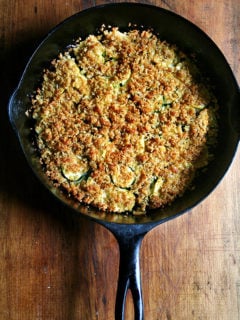
Summer Squash Gratin

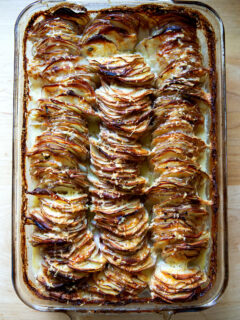
Summer Squash Gratin

This is the recipe that broke the streak. A two-month-long, five-meal-rotation streak consisting of burgers, meatloaf, roast chicken, burgers and quiche. It was time. It was time to put some effort into dinner; to try something new; to open up a can of anchovies; to crack a jar of capers; to pour some brown butter over fresh bread crumbs. Yes, brown-butter bread crumbs. They are so good.

Let me tell you, my efforts paid off. I’m all about simple recipes these days, and when I have fresh ingredients on hand, simple can be best. But this recipe reminded me of ones I used to attempt all the time, ones with so many layers of flavors and textures, ones that leave eaters guessing, “what is that?” after every bite.

And don’t let me scare you: There’s nothing complicated about making this dish. It’s just that for me these days, anything that requires more than forming burger patties and tossing a salad seems like a chore. I took a few shortcuts, too, opting to make the salsa verde in one step in the food processor, which saved a wee bit of time, but I encourage you to read through the original recipe first on Food 52. It’s a fabulous site!

If you’re in need of a nice, summery, vegetarian dish to add to the mix, this is the one. It’s light — no cream in this gratin — and the vegetables remain firm even after 40 minutes of cooking. I served it as an entrée with a simple salad and some fresh bread, but it would make a wonderful side dish as well.

For all of you fathers out there, have a wonderful Father’s Day weekend! And to the four father’s in my life, I love you very much.

Summer Squash Gratin

Salsa Verde Ingredients

Salsa Verde

Mise en Place

Summer Squash from our Olin-Fox Farm CSA:
Ingredients In Bowl

Tossed Ingredients

Uncooked Gratin

Kitchen assistant sneaking a bite:
Sneaking a Bite

Kitchen assistant caught in the act:
Kitchen Assistant

Summer Squash Gratin with Salsa Verde and Gruyère

Source: Food 52 via Suzanne Goin
Serves 4 as an entrée

Salsa Verde:

1 teaspoon fresh marjoram or oregano leaves (1/2 teaspoon dried)
1/4 cup coarsely chopped mint
1 cup coarsely chopped flat-leaf parsley
3/4 cups extra-virgin olive oil
1 small clove garlic
1 anchovy
1 tablespoon capers, drained (rinsed if salt-packed)
1/2 lemon, for juicing
Freshly ground black pepper

Gratin:

2 pounds summer squash
1 1/2 cup fresh breadcrumbs
3 tablespoons unsalted butter
3/4 cups sliced shallot
1 teaspoon minced garlic
1 tablespoon thyme leaves
1 New Mexico chile or jalapeno, seeded and finely chopped
1 cup grated Gruyere cheese
Kosher salt and freshly ground black pepper

1. Make the salsa verde. Using a mortar and pestle (or a food processor), pound the herbs to a paste. You may have to do this in batches. Work in some of the olive oil, and transfer the mixture to a bowl. Pound the garlic and anchovy, and add them to the herbs. Gently pound the capers until they’re partially crushed, and add them to the herbs. Stir in the remaining oil, a pinch of black pepper, and a squeeze of lemon juice. Taste for balance and seasoning. (Note: I basically made this in one step in the food processor — I pulsed everything with the exception of the capers together, then stirred the capers in at the end.)

3. Make the gratin. Heat the oven to 400 degrees. Cut the squash into 1/8-inch-thick slices. (A mandolin makes this a quick task.) Toss the slices in a large bowl with 1 teaspoon kosher salt, and let sit 10 minutes.

4. Place the breadcrumbs in a bowl. Heat a small saute pan over medium heat for 1 minutes. Swirl in the butter and cook for a few minutes, until it browns and smells nutty. Pour the brown butter over the breadcrumbs (being sure to scrape all the brown bits into the bowl with a rubber spatula). Wait a minute or so for the butter to cool, and toss well.

5. Drain the squash and transfer it to a large mixing bowl. Add the shallots, minced garlic, thyme, chile, 1/2 cup salsa verde, and some pepper. Toss to combine, and add the cheese and half the butter-coated breadcrumbs. Toss again, and taste for seasoning. (The raw garlic will taste strong at this point but will be delicious when cooked.)

6. Place the squash in a pretty 9-by-9-inch (or equivalent oblong-shaped) gratin dish. Scatter the remaining breadcrumbs over the top, and bake 35 to 40 minutes, until the squash is tender and the top is crisp.

Summer Squash Gratin

Crispy Kale Chips

Crispy Kale Chips

They’re sort of one of those things you have to try to believe. When a friend proclaimed she and her husband (who has been known to drive 40 minutes for his favorite burger) preferred kale chips to potato chips and even to french fries, I had my doubts. It was about time I tried for myself, however. I’ve only been reading about these crisps on the blogosphere for about 3 years.

Well, what can I say? If you think you can’t eat a head of kale in one sitting, think again. You can, and you will. In fact you might find that one head is not enough for one sitting. And you might find that 8 heads of kale from the farmers’ market won’t suffice for the week. And you might find yourself panicking mid-week, making stops to your not-so-favorite market to preemptively restock your supply. I mean it. These kale chips are that good. It would make me so happy if you tried for yourself.

Crispy Kale Chips

Serves 1 to 2

1 bunch kale*
extra-virgin olive oil
kosher salt
*Of course bunches vary in size, but this recipe is not precise anyway. Also, there are many varieties of kale. I’ve made this recipe with at least 3 different varieties, and they all are delicious.

1. Preheat the oven to 350ºF. Tear kale into smallish-sized pieces as pictured above. Toss lightly with olive oil and kosher salt. Spread evenly on a sheet tray. Don’t be afraid to fill it up — it shrinks way down while it bakes (see picture below.)

2. Place sheet tray in the oven for about 15 minutes. Reach inside being careful not to burn yourself and feel the kale pieces. They should feel slightly crispy. If the pieces are not crispy at all, keep cooking for another couple of minutes.

3. Remove sheet tray from the oven and place on cooling rack for a minute or two. Eat! Once you make this recipe once or twice, you’ll discover how long it takes for a batch to cook. Some pieces will always be overcooked; some will be undercooked; but most will be delicious! Enjoy.

Homemade Applesauce

applesauce

You all know it takes no time to whip up homemade applesauce, right? And you know how good it is, too, right? Just a quick little post here to make sure. I’ve been enlisted to make applesauce for this Thanksgiving so I’ve been practicing.

Oh, there is one stipulation. You sort of need one of these, a Foley food mill. They’re cheap, which is good, because it will likely sit in your cupboard for 10 months out of the year. I only use mine to make applesauce. Am I missing something? Are there other recipes out there requiring a food mill? If you know of any, please share.

Also, I’m afraid my mother would be deeply disappointed if I didn’t mention one thing: Apples top the “Dirty Dozen” list. And apparently, scrubbing and peeling doesn’t eliminate chemical residue completely, and you definitely want to keep the skins on when you make applesauce — that’s where all the flavor lives. So with apples, it is ideal if you can purchase organic or if you can purchase from your local-but-perhaps-not-certified-organic-though-organic-in-every-sense-of-the-word apple farmer. Make sense?

Happy Thanksgiving!

food mill

Homemade Applesauce

Yield= A Lot

3 lbs. apples, about 10 smallish apples*
1 cup water

1. So, there isn’t really a recipe here, just a method. Cut apples into big chunks — cut straight down around the core and discard it. Place them in a large pot with about a cup of water. Cover the pot, bring it to a boil, reduce the heat, and simmer until the apples are very tender, about 20 minutes. This can take more or less time depending on the variety of apples you’ve chosen to use and the number of apples you have jammed in the pot. After you make this once or twice, you will have a better sense of the water-to-apple ratio.

2. Once the apples are tender, spoon them into the food mill in smallish batches. Start cranking. You may or may not need all of the liquid remaining in the pot. That’s it. You’re done!

*Any variety of apples will do, but I have been partial to Fuji and Lady Pink, because I can get those varieties at my farmers’ market.

A Super Summery Pasta

I am obsessed with roasted red peppers at the moment. I have been preparing them by the half dozen and using them all week chopped up in salads or left whole in sandwiches or laid atop a bagel with cream cheese. They are so delicious.

There are no roasted red peppers in this pasta dish, however. But I did discover a revolutionary way to use all of those lovely juices generated by roasting peppers. More on that later.

As for this pasta dish, it’s another one I learned while working at that Philadelphia restaurant. As soon as the Branch Creek cherry tomatoes — the sweetest, most flavorful cherry tomatoes I had ever tasted — arrived each summer, this dish would appear as a first course on the menu. And it was a huge hit, a perfect start to a summer dinner.

It’s simple to prepare: Sauté cherry tomatoes with orecchiette, ciliegene mozzarella and basil pesto. Add some fresh basil just before plating along with some shavings of Parmigiano Reggiano and fresh cracked pepper. Yum yum yum. Toasted pine nuts, I think, would make a nice addition to this pasta as well.

So, I normally avoid buying jarred sauces, tapenades, pestos, etc. but I have an amazing Italian deli in my town that sells enormous jars of delectable pesto at a very reasonable price. It’s hard to pass up and makes for very easy preparations. So, if you have a good local source for pesto, by all means use it in this dish — everything else will take minutes to prepare.

Now, onto my revolutionary discovery regarding roasted red pepper juices. First of all, I cannot believe I have been discarding those juices all these years. I mean, I have always stored my peppers in their juices in a bowl in the fridge but once the last pepper has been consumed, those juices go down the drain. I had never before thought to drizzle them over pasta for added flavor or to reheat them with last night’s pasta, as I did yesterday with this very dish, which was extremely delicious.

Oh it pains me to think about! What a waste. Am I the last person on the planet to have discovered this? Have all of you been creatively and resourcefully using your roasted red pepper juices all these years? If so, pray tell how.

I am anxious to try the recipe here with roasted red peppers substituted for the tomatoes, goat cheese for the mozzarella, and red pepper juices for the pesto … ooooh, I think another super summery pasta dish is in the works.

Orecchiette with Cherry Tomatoes, Mozzarella & Basil Pesto

Serves 4 as a starter or 2 generously as an entrée

1/2 lb. orecchiette pasta
kosher salt
2 T. olive oil
1/2 lb. cherry tomatoes, halved (I used more like 9oz., and you could probably use even more)
2 T. basil pesto
1/2 lb. ciliegene (small balls) mozzarella*
fresh basil**
shaving of Parmigiano Reggiano (optional)
fresh cracked black pepper

* Goat cheese would be a nice substitute.
** If you have small tender leaves, leave them whole; otherwise, chiffonade the basil
*** Toasted pine nuts or walnuts would make a nice addition to this pasta as well.

1. Bring a large pot of water to a boil. Add a pinch of kosher salt. Add pasta and cook till al dente, about 9 minutes. (Package instructions said 11 minutes but the pasta will continue cooking as its tossed with the other ingredients so it’s best to undercook it a little bit.) Drain pasta. Do not rinse.

2. Heat olive oil in a large skillet over high heat. Add the cherry tomatoes and cook for 30 seconds. Add pasta and pesto. Cook 1 minute, stirring to coat pasta with the pesto. Add the mozzarella. Stir to incorporate. Add the fresh basil and remove from the heat.

3. Divide pasta among bowls and sprinkle each with some fresh shavings of Parmigiano. Crack the pepper overtop and serve.

Fingerling Potatoes with Rosemary and Thyme, Crispy or Not

I learned how to cook potatoes by the caseload. By the caseload of salt, too. Seriously. I was working in a restaurant in Philadelphia and gasped the first time I saw the chef unload a box — literally one 3-lb. box — of kosher salt into a pot, albeit a very large pot, filled with fingerling potatoes, water, many cloves of garlic and several bunches of rosemary and thyme.

Bring the water to a boil, he instructed, then turn off the heat. The potatoes, he ensured, would finish cooking as they cooled.

He was right. The potatoes were cooked perfectly, not the slightest bit overdone. And moreover, they were seasoned perfectly, too, not a bit too salty and subtly infused with the flavors of rosemary, thyme and garlic.

These days, I eat these potatoes straight out of the pot with not a bit of extra seasoning. They are excellent, too, sliced and tossed into salads.

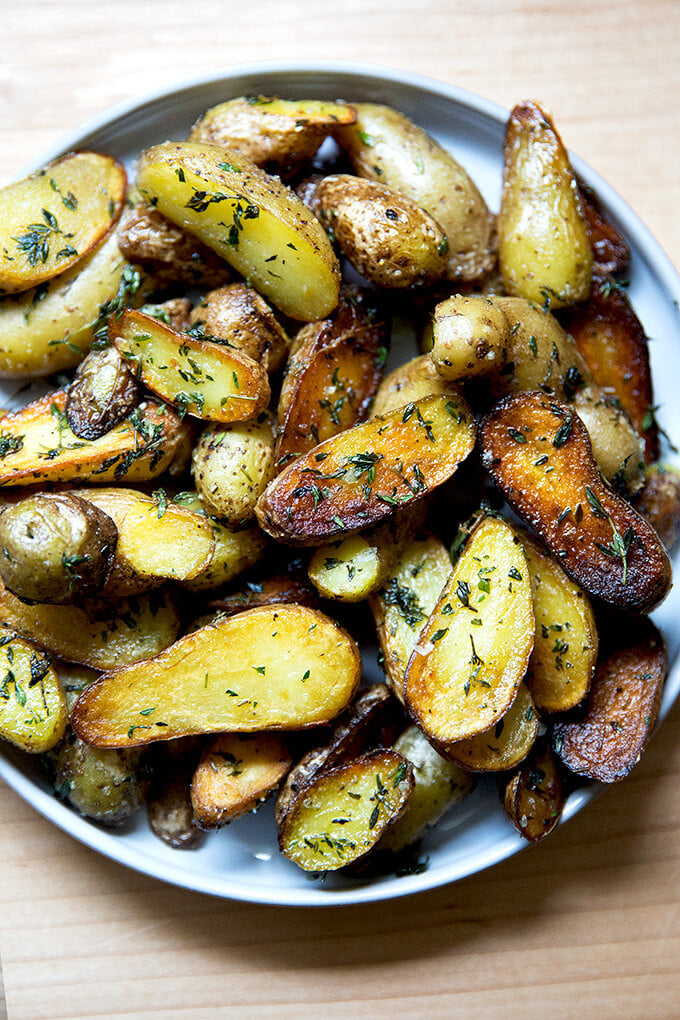
But when I’m not feeling so lazy, I go the extra mile and crisp them up, as I learned to do at the restaurant, with a bit more rosemary and thyme and a pinch more salt. And then I splash Sriracha all over them. It’s such a treat. I think you’ll like them, too.

Fingerling Potatoes, Crispy or Not

Serves 2-4

1 1/2 lbs. fingerling potatoes
1/4 cup + 2 T. kosher salt
several sprigs of rosemary and thyme
2 cloves garlic, smashed

olive oil
kosher salt
a few more sprigs rosemary and thyme, leaves removed and minced

1. Place fingerlings in a pot. Cover with approximately one inch of water. Add the salt, herbs and garlic. Bring the pot of water to a boil, then turn off the heat. Let the potatoes cool completely in their liquid before proceeding.

2. Once cool, you can eat the potatoes as they are or you can brown them. These potatoes are wonderful to have on hand — they are truly delicious cooked as they are, sliced and tossed into salads or just eaten straight out of the refrigerator.

3. If you want to crisp them up a bit, slice the potatoes in half on a bias (or leave them whole if they are really small). Then, heat a pan (preferably cast iron or carbon steel or stainless steel) over high heat. Add a thin layer of olive oil and swirl the pan to coat the bottom — the pan and oil should be very hot before adding the potatoes. Add the potatoes, shake the pan once and then let them be. Do not disturb them for a minute or two. Check one before trying to shake the pan or stir them with a spoon — you want that edge to get crispy and it won’t get crispy if you try to move them too quickly.

4. Once the fingerlings are browning nicely, shake the pan, toss in the herbs and give them a pinch more of kosher salt. Serve immediately. I like to eat mine with Sriracha. Yum!