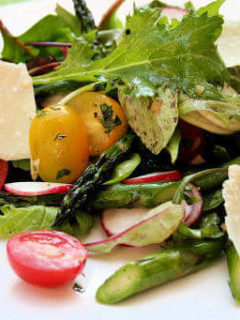
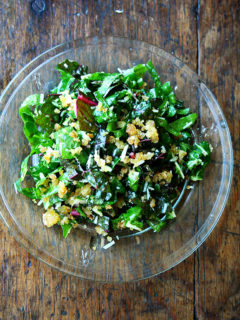
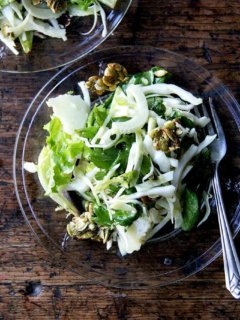
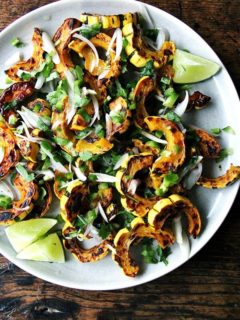
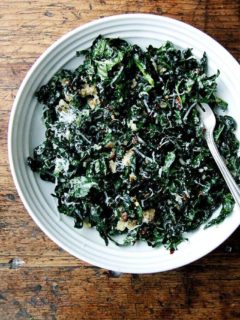
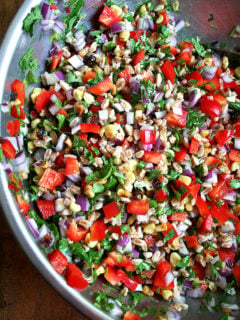
So, you see my vision. It’s nothing earth-shattering. A classic combination, really. But a timeless one, and one I think will be festive for Thanksgiving Day.
So, to execute this salad, all I need to finish tweaking is my recipe for poached pears. The pecans I’ve got down to a science, (for me at least — I’ll explain in a bit); the dressing, made with reduced orange juice, white balsamic vinegar and olive oil, has been tested countless times (Aunt Vicki’s recipe, to be provided next week); the blue cheese (perhaps Stilton or Maytag) and the endive merely need to be purchased. The pears, however, have been giving me a little trouble this past week. I’ve been working with a combination of white wine, sugar, orange zest, cinnamon stick and vanilla bean. Something is not quite right yet. Any suggestions are welcome.
Now, about these pecans. I’ve been making this recipe for several years now, and I find it produces the crunchiest, most delicious candied pecans. I’m not promising a simple and foolproof recipe, however. It’s the kind of recipe, in fact, that could potentially lead you to swear off my recipes altogether.
The first two-thirds of the recipe is simple: the pecans are blanched for two minutes, then simmered in simple syrup for five minutes. The final third of the process, which calls for deep-frying the pecans, is where problems can arise. I suggest using a deep fryer with a built in thermometer. My deep fryer continues to exist in my kitchen solely for the purpose of making these pecans — it keeps the oil at 375ºF, which is key for this recipe. I tried deep-frying the pecans in a heavy-bottomed pot on my stovetop once, and the process was so frustrating: At first the oil was too hot, then it wasn’t hot enough, and before I had finished frying, I had ruined nearly half the batch.
The key, I’ve learned, is to let the pecans fry for about 3 to 5 minutes — the longer they fry, the crunchier they will be. However, they must be removed from the oil before they burn, and they continue to cook a little bit once they’ve been removed from the oil. It’s a trial-and-error process, but one well worth it in the end. I highly recommend using a deep fryer with a built-in thermometer, but if you are comfortable with stove-top deep frying, by all means go for it.
1. Bring a medium pot of water to a boil. Add pecans and simmer for 2 minutes. Drain and rinse under cold water.
2. Combine the sugar with 1 cup of water and bring to a simmer. Simmer for 2 minutes, add pecans and simmer for 5 minutes. Drain.
3. Meanwhile, preheat a deep fryer to 375ºF, or pour canola or peanut oil into a heavy-bottomed pot to reach at least one-inch up the sides and fix a deep-fry thermometer to its side. When oil is ready, fry pecans for 3 to 5 minutes in small batches. This will be a trial-and-error process. The longer the pecans fry, the crunchier they will be. If the oil is too hot, they’ll burn before they get crispy. So, fry the pecans in small batches until you can read your oil. Remove pecans from fryer with a slotted spoon or spider and let drain on cooling rack or parchment paper — not paper towels. Repeat process until all pecans are fried. Refrain from sampling until the pecans have cooled completely — they’ll be crunchier and tastier when they are completely cool.
This recipe begins with raw (unblanched, unroasted, unsalted) pecans: They are blanched for two minutes in boiling water, then drained: Then they simmer in a sugar syrup for five minutes: Then they are drained again before being deep-fried for three to five minutes.
It has been done to death. Caprese salad that is. But there’s a reason it appears on nearly every restaurant menu come summertime: It’s so unbelievably good. I promise I’m not trying to bore you. I just have have a few things to add, in an effort, I hope, to maximize your tomato-eating experience this summer.

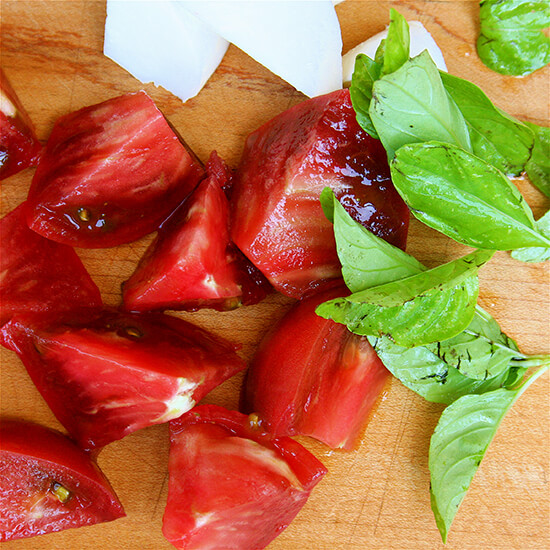
1. Tomatoes. I’m sort of stating the obvious here, but likely the tomatoes you pick up at your local farmers’ market will be superior to store-bought varieties. This past Sunday at the San Clemente farmers’ market, I learned from one of the Carlsbad farmers that the darker tomatoes tend to be sweeter. The man wasn’t lying. The tomato pictured in the upper left corner of this photo was the sweetest and tastiest of the bunch. It reminded me of a variety I discovered last summer, back in Philadelphia, called Black Prince, which I loved for the same reasons.
2. Fresh basil. Nothing like it. So fragrant. So sweet.
3. Mozzarella. I hate to be a snob, but buffalo mozzarella is so good, and there’s really nothing like the imported Italian varieties. However, as we are all so aware of our food miles these days, we can make smarter choices. I just discovered this Bubulus Bubalis mozzarella, which is made in Gardena (near L.A.) from the milk of water buffalo grazing in Northern California, if I understood the story correctly. Anyway, it is exceptional. And for Philadelphians, Claudio’s mozzarella is wonderful. (For all of you in between CA and PA, I wish I could give you more direction. Alas, my knowledge extends only to two places.)
4. Salt. Invest in a small tub of nice salt, like this one pictured below. I use it only on special occasions, like when I’m salting tomatoes or salting avocados or salting butter spread onto bread. So, basically I use it every day. My sister found this little tub in France earlier this summer but any variety of nice sea salt will do. (If you can’t resist this precious container, you can buy it from Salt Works.) And don’t be afraid to give the tomatoes a real sprinkling — I swear it makes them sweeter not saltier. Really.
5. Olive Oil. With good tomatoes, a drizzling of extra-virgin olive oil is the only dressing needed. I have yet to add a splash of vinegar to my tomato salads this summer. Though a splash certainly wouldn’t hurt. And it does make a nice little sauce to soak bread in.
6. Preparation. Try cutting your tomatoes into irregular shapes as opposed to thin slices. They look prettier; they’re easier to eat; and the tomatoes taste better, too. Really, they do. Cut the mozzarella the same way. And when you arrange it all on a platter, don’t toss it around to much. Just sprinkle the tomatoes and cheese with salt; tear basil leaves over the top; drizzle it with oil; and serve.
Two very hot peppers, cherry tomatoes, one heirloom tomato and a few very tired sprigs of basil picked from my garden. Yay, the tomatoes are turning red! I am particularly enjoying the dark red heirloom tomatoes. They are sweet and delicious. I found these along with Bubulus Bubalis mozzarella at the Santa Monica farmers’ market this past Wednesday.
So, I sort of have this habit. I tend to add cheese to every salad I make. In large quantities. And often nuts, too. And maybe dried fruit if I don’t have any fresh on hand. I tend to turn salads into mini meals themselves, even when, as I often am, just serving them on the side.
For whatever reason, I refrained from adding more than what was prescribed in this recipe: melon, cucumber, lettuce and a mint vinaigrette. And I’m so glad I did. This salad does not need anything else. It is light, refreshing, summery — perfect as is. Thank you Sarah Cain at the Fair Food Farmstand 2,378 miles away in Philadelphia for supplying such a wonderful recipe in the weekly “At the Farmstand” email.
Now, for my friends out there looking for simple recipes, this one is for you. If you can chop up a melon and a cucumber, you can make this dish. The dressing is made right in the jar, which means no whisking and minimal cleaning. I love it, and you will too.
The dressing for this salad is made right in the jar: Equal parts vinegar and oil along with a pinch of sugar and salt, a dab of mustard and tons of mint and parsley combine to make a bright and flavorful dressing.
Cucumber And Melon Salad with Mint Vinaigrette Recipe Courtesy of Sarah Cain, Supervisor of the Fair Food Farmstand in Philadelphia Great with a grilled meat, especially lamb. Serves 4
½ cup of extra virgin olive oil ½ cup of best white wine vinegar (I used rice vinegar and loved it.) ½ teaspoon of dijon style mustard 3 tablespoons of finely minced fresh mint 1 tablespoon of finely minced parsley big pinch of sugar big pinch of salt 2-3 cups mixed honeydew, cantaloupe and watermelon, peeled, seeded and diced 2 cups mixed greens 1 English cucumber, diced
1. In a jar with a tight fitting lid, combine the dressing ingredients. Shake like crazy. Let stand a room temp for 40 minutes to meld the flavors.
2. Meanwhile, combine the melon, greens and cucumber in a large bowl. (I also added some more mint and parsley (roughly chopped) to the salad.)
3. Shake the dressing vigorously before pouring just enough to moisten the chunks of melon, greens and cucumbers.
There’s something about the combination of raw (or briefly blanched) and young (or thinly shaved) vegetables with Pecorino Romano cheese that I find irresistible. Which vegetables meet this criteria? I can name only a few — asparagus (shaved), fennel (shaved), fava beans (briefly blanched) and summer squash (julienned on a mandoline) — but many more exist. When fresh, these vegetables need little more than salt, pepper, olive oil and lemon juice — no cooking is necessary (with the exception, of course, of the fava beans).
After discovering this zucchini salad last summer, I prepared it often, and on more than one occasion, made myself sick to my stomach. I think raw zucchini might be a little harsh on the stomach? Don’t let that deter you, however. Just a little warning.
Now, why Pecorino over Parmigiano? Parmigiano Reggiano would be a fine substitute, but there’s something about Pecorino that I’m really liking these days — I think it’s its saltiness. Cut it the same way as in the fava bean and pecorino salad: Stick the tip of a big chef’s knife right into the block and twist until nice chards break from the block.
Zucchini and Pecorino Salad Serves 2 as a side dish
1 zucchini, about 8-inches long Pecorino Romano cheese, to taste kosher salt freshly ground pepper extra virgin olive oil 1 lemon, halved
1. Shave the zucchini on a mandoline into thin spaghetti-like strips. Place in a bowl. Stick the tip of a big chef’s knife into a wedge of Pecorino and twist until nice chards break from the block. Add to the bowl. Season with salt and pepper to taste. Drizzle olive oil over the mixture. Squeeze with lemon. Gently toss and serve.
I cook fava beans once a year. When I spot the first of the season at the market, I fill up a bag, take them home and set to work, peeling, blanching and then peeling again. I open Alice Waters’ Chez Panisse Vegetables and weigh my options: purée them and stir them into risotto or eat them raw with prosciutto and Pecorino. I’m sorry, but anything that calls for two peelings is not going into my blender. And so, I eat the fava beans raw, tossed with olive oil and lemon juice and mixed with parmesan or Pecorino. And I don’t share them with anyone because the two pounds I peeled yields only enough for a small snack. But they are so good. Definitely worth the double peeling. At least once a year.
OK, so I’m being a little dramatic, but seriously, fava beans are a lot of work. I will cook them more than once this year, and I will share them, but I will cook them only at opportune times, like when I invite friends over who have small children with little fingers who will work swiftly.
With this salad, I like the Pecorino to be in big chunks. I’m a big fan of shaving cheese with a peeler or with a sharp knife, but with this salad I use a different technique: I stick the point of a large, sharp knife directly into the block of Pecorino and twist. It breaks into nice, flaky shards. Parley is a nice addition to this salad, but not critical. And a finely chopped shallot or red onion is also a nice touch.
Fava Bean and Pecorino Salad Serves 4
2 to 3 lbs. fresh fava beans, shelled kosher salt freshly ground black pepper 4 oz. Pecorino Romano extra-virgin olive oil 1 to 2 lemons finely chopped parsley
1. Bring a large pot of water to a boil. Add the fava beans and cook for one minute. Drain, then plunge the beans into an ice bath and let cool. Drain again. Peel the beans and place into a mixing bowl.
2. Season with salt and pepper to taste. Break the Pecorino into big chunks and sprinkle them into the bowl.
3. Drizzle olive oil over the mixture and toss. Sprinkle with lemon juice to taste. Add the parsley, toss again, and serve.
OK, I know, my consumption of oranges and avocados is getting out of hand. What’s pictured below is just my mid-morning snack. Ben drew the line last night before dinner. He told me he was starting to get “freaked out.”
To be fair, let me put his comment in context. For the most part, we have been eating the widely recognized Hass avocados — the dark, rough-skinned variety. Last night, however, I changed things up a bit and pulled out the Ettinger avocado I had purchased at the Sunday farmers’ market. A woman working at the Eli’s Ranch table told me Ettinger avocados have a “buttery texture” and “a pine nut flavor.” They also look like ostrich eggs, which I believe is what freaked Ben out.
I told Ben to look away as I sliced into its flesh. I didn’t want him to lose his appetite. Once on the plate, sprinkled with a little salt, however, these avocados look just like all the others, and Ben could eat his meal in peace.
Blood Oranges. Since reading a post in Matt Bites about a blood orange and campari cocktail I have been wanting to a.) make the drink and b.) experiment more with blood oranges. I have yet to make the cocktail but I have been eating my fair share of blood oranges. Mixed with avocados, sprinkled with sea salt and drizzled with olive oil, they make a yummy, simple salad or, as I mentioned above, a nice mid-morning snack.
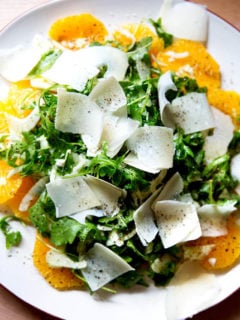
Last night, I made a vinaigrette using the juice of two blood oranges, shallots, olive oil and salt (using the same method described on the sidebar below) and tossed it with arugula and shaved parmesan. Yum.
That’s all for now. I will try to refrain from mentioning oranges and avocados in the near future.
A Simple, Yummy Snack Serves 1
1 avocado sea salt 2 blood oranges good extra-virgin olive oil
1. Cut the avocado in half. Remove the pit. Scoop out the flesh. Cut into large chunks. Place on a plate. Sprinkle with sea salt.
2. Slice off the ends of each orange. Using a sharp knife, slice off the peel, removing as much of the pith as possible. Cut the orange into large chunks and add to the plate of avocados. Season with a touch more salt.
3. Drizzle with olive oil. Eat.
A crate filled with Ettinger avocados. OK, so they don’t really look like ostrich eggs, but they are significantly larger than Hass.
Before I moved out to California, Bob Pierson, director of Farm-To-City, told me my new state would be decades ahead — agriculturally speaking — of the East Coast. While I have been amazed at the number of farmers’ markets out here, only after yesterday am I beginning to understand what he meant.
You see, despite the obscene amounts of avocados and oranges I’ve been delighting in, I’ve actually spent the past month feeling proud of Philadelphia and the diversity of local foods available to those living in and around the city. While the farmers’ markets run only from May until December, Philadelphians can shop year-round at the Fair Food Farmstand and have the option of joining buying clubs during the winter. As I mentioned recently, I lived ten blocks away from a source for local grass-fed beef, lamb and pork, raw milk, raw-milk cheeses, nitrate-free bacon, fresh chickens, eggs and seasonal fruits and vegetables.
I have encountered no such stand or source like the Fair Food Farmstand in my time thus far on the West Coast. Now, I could eat sautéed Swiss chard, mustard greens, kale, etc. mixed with rice and parmesan every night. However, I do have a husband to feed, and my recent dinners, I suspect, have left him wanting. The last time I made a meatless dinner, Ben said, “Mmmm, this is delicious,” and he cleared his plate. About an hour later, he was scrambling eggs and scouring the fridge for a morsel of protein to add to the pan.
So, I ventured down to San Diego two days ago to attend a Roots of Change meeting in search, I’ll admit, of meat. I wandered into the room, spotted the legendary Melanie Lytle and claimed a chair at her table. Before long, I saw the California Bob Pierson had described.
Like many people across the country, Californians are concerned about the current state of our food system and the future health of our communities and planet. These worries foremost, believes Larry Yee (County Director), are driving the “food revolution.”
People partake in this revolution in countless ways: by using reusable shopping bags at the grocery store; by boycotting bottled water; by shopping at farmers’ markets; by joining CSAs and buying clubs; by shopping for humanely raised meats; by purchasing organic and locally grown foods.
California, I learned, has taken this effort to the next level: Roots Of Change has drafted a comprehensive plan to create a sustainable food system in the state of California by the year 2030. This plan demands the collaboration of food producers, food distributors, businesses, nonprofits, government agencies, foundations, etc. As Yee noted, a sustainable food system — not just a sustainable agriculture system — is the goal of this ROC initiative. In a state where many people with diverse interests coexist, an “enlightened leadership,” says Yee is critical to the success of this project.
Yesterday, I learned a lot about my new state and, in particular, San Diego County:
California is:
• the nation’s most populous state; the nation’s largest food producer; and the world’s 5th largest supplier of food and agricultural commodities.
In San Diego County:
• there are more organic farms than any other county in the country. • 63% of the farms are 1 to 9 acres. • 92% of the farms are family owned. • 22% of the farms are Native-American owned.
California, many of the speakers noted, is the most important agriculture place on Earth. With its countless forward-thinking foundations and entrepreneurs, California sets the trends for the world.
About half-way through the meeting, Michael Dimock, (President of ROC and MC of the event), passed the mic to the crowd.
• Naomi Butler, a nutritionist with the County of San Diego, stressed the importance of getting food into our school systems via garden and farm-to-school programs. We have to start, said Butler, “by changing the taste buds of our kids.”
• A young, private chef emphasized educating children on these matters because “they are the future.”
• Others inquired about increasing points of contact — farmers’ markets, co-ops, distribution centers, etc.
• One chef noted, “We have particular issues down here,” referring to the unique problems facing San Diego County. She worried about the welfare of the Spanish speaking community — how are we going to deal, she wondered, with immigration?
• One woman noted the number of farmers that will soon retire (a nation-wide reality) — what will happen to their farms?
While the challenges are vast, the bottom line, as Eric Larson (Executive Director of the San Diego County Farm Bureau) concluded, is straightforward: profitability. If farms are profitable, they’ll stay in business. Farmland is expensive in California and in a globalized world, small farmers face serious competition.
I drove home from the meeting feeling slightly overwhelmed, but understanding this: We have a lot of small farms in San Diego County. These small farms use organic and sustainable techniques. Our health as a community rests on the survival of these small farms. And the survival of these small farms demands the work of many hands.
I feel a little embarrassed knowing I had ventured down to the meeting primarily to learn how I could find meat for Ben and me. There are far more important issues to tackle, namely getting good food into schools and low-income communities. Alas, I am inspired by the many people involved in this daunting task, and hope to play a role in the ROC’s effort. Want to pitch-in? Join the ROC Leardership Network.
As I mentioned in my last post, the farmers’ market arugula has been delectable, tasting particularly spicy. This bunch comes from Don’s Farm in Wildomar, CA (purchased at the Sunday San Clemente farmers’ market … shocker). As Don calculated my total, he looked a little nervous, apologizing for some of the dirt, explaining he had pulled the arugula out of the ground in complete darkness at 4:00 that morning. Don had nothing to worry about — a quick soak in cold water removed any lingering dirt. Besides, for greens this fresh and tasty, anyone can live with a little dirt.
I find a simple lemon vinaigrette to be the best dressing for arugula, (a deduction likely influenced by my love for Melograno’s arugula and prosciutto salad). I don’t have a precise recipe for this dressing, but I follow Alice Waters’ method as described in Chez Panisse Vegetables. She begins many of her vinaigrettes by macerating finely chopped shallots for about 20 minutes in either citrus juice or vinegar. She then adds salt, pepper, sugar, maybe mustard (I don’t have my book on hand to verify), finishing each dressing by slowly whisking in extra-virgin olive oil. It could not be simpler.
Arugula, Orange & Avocado Salad Serves 4
1 shallot, finely diced 1 to 2 lemons, depending on size sugar, to taste kosher salt and freshly ground black pepper, to taste extra-virgin olive oil
1. Place the shallots in a small bowl. Squeeze the lemons over top, removing any seeds that fall in. Let sit for 20 minutes.
2. Meanwhile, prepare the salad: Place the arugula in a large bowl filled with cold water to soak. Peel the oranges, removing sections from the pith if desired. Slice the avocados in half; remove the pit; scoop out the flesh; and slice into strips or dice into cubes. Set aside.
3. To the bowl of shallots, add a ¼ teaspoon of sugar, a pinch of salt and pepper to taste. Slowly whisk in the oil. The mixture won’t totally emulsify. Taste, adjusting seasoning as necessary (with more sugar or oil, for example, if the mixture is too tart).
4. Drain the arugula and spin dry. Place the arugula in a bowl. Top with the oranges and avocados. Add dressing to taste. Toss gently. Divide among plates. Top each salad plate with a few shavings of Parmigiano Reggiano.
I cannot believe it, but today my blog celebrates its one-year birthday. Exactly one year ago today, I wrote about quince membrillo, a sweet paste commonly served with several Spanish cheeses including Manchego, Roncal, Idiazabal and Zamorano. This past week, I introduced two good friends and their family members to membrillo and the tradition of eating membrillo with sheep’s milk cheeses. My friends, Emily and James, married in Cyprus July 18, celebrated their marriage stateside this past Sunday in Chapel Hill, and in the days leading up to the festivities, we enjoyed many delectable dinners together commenced with this classic combination.
While in North Carolina, Emily and I spent a good hour one day touring around a gourmet food shop, A Southern Season, where I found among many goodies a large selection of Cypress Grove cheeses (Cypress Grove makes Humbolt Fog). Being vegetarians, James and Emily try to eat cheeses specifically made without rennet, a coagulating enzyme made from the stomach of calves. Many, if not all, of Cypress Grove cheeses are made with a vegetarian rennet, including a yummy sheep’s milk cheese called Lamb Chopper, which we savored with the membrillo. We actually enjoyed the fruit paste with all of the cheeses — Brie, Morbier, Tomme de Savoie — we ate this past week, but the Lamb Chopper-membrillo combination proved the best of all.
My week in North Carolina to say the least was memorable. By the end of each day, my face hurt from smiling and laughing so much — I lived with James’ family for the week, a family of four funny children, two entertaining parents and two wonderful dogs. We played Scrabble and ping pong, watched Mostly Martha and Grizzly Man, took walks with Molly and Sally (the dogs), and generally just enjoyed the time spent together with good company.
On one of the first nights of my visit, we also enjoyed thin slices of Fuyu persimmons with all of the cheeses. Fuyu persimmons make a nice seasonal addition to many dishes, including salads and paninis. Available from September through December, persimmons peak in November, perfect timing for the Thanksgiving Day feast. If you’re sill searching for a first course to prepare for Thursday’s meal, try this salad — elegant, seasonal and delectable — a festive addition to the Thanksgiving Day table.
Mache and Persimmon Salad Serves 4
2 small shallots 2 tablespoons champagne vinegar 2 tablespoons lemon juice ½ teaspoon Dijon mustard ¼ teaspoon sugar ½ teapoon kosher salt 1/3 cup extra-virgin olive oil 2 Fuyu persimmons 4 oz. piece of Parmigiano Reggiano 8 oz. mache freshly ground pepper
To make the dressing, whisk the shallots, vinegar, lemon juice, mustard, sugar and salt together. Slowly drizzle in the olive oil, whisking constantly to make an emulsified dressing. Set aside.
Cut the ends off each persimmon. With a paring knife, slice off the skin, removing as little flesh as possible. Using a mandoline, cut each persimmon into thin slices. (Alternatively, slice thinly using a sharp knife.) Set aside
Using a peeler or a knife, shave thin long strips off the block of Parmigiano. Set aside.
Place greens in a bowl and toss lightly with the vinaigrette. Divide the slices of persimmon evenly among the plates. Top each with a generous handful of greens. Top with the cheese shavings. Crack pepper over each salad and serve.
Several weeks ago, just before my friend Meredith (fourth year medical student, see previous entry) departed for a grueling one-month surgical rotation in Pittsburg, Ben and I had the pleasure of dining with her and her fiancé, Matt (private chef on the Main Line). We again chose Sovalo — Matt and Mere’s favorite spot — and again delighted in a wonderful dinner.
Some of the more memorable dishes of the evening include a homemade ravioli stuffed with figs, a tortelli tossed with duck confit and mushrooms, and a crispy pan-seared red snapper. The shaved fennel and Parmigiano Reggiano salad, however, tossed lightly in a lemon vinaigrette and served with prosciutto di Parma and fresh figs, was perhaps the favorite selection of the evening.
The combination of fennel and Parmigiano never fails to please but the addition of prosciutto and figs made every bite in this appetizer truly delectable. While I haven’t made a trip to the Fair Food Farmstand in a couple weeks (so sad! CSA season has ended), I doubt they still have this variety of figs, though they carried them through the first week of October at least. With a tender green skin and a brilliant magenta-colored and sweet-tasting interior, these figs make any salad restaurant worthy. Black mission figs, however, the variety served at Sovalo, will more than suffice.
We concluded the evening with two desserts, one of which we particularly enjoyed/attacked: a biscotti tirimisu layered with fruit and I believe some sort of custard, but that part of the evening, to be honest, is a touch fuzzy … cockails at the bar before dinner, wine during, Frangelico and coffee for some (me) after, and Port for all, suddenly add up — afterall it was a bon voyage dinner for our poor Pittsburg-bound Mere-Mere. Only two more weeks Mere!
Fig and Fennel Salad Serves 4
2 fennel bulbs olive oil 1 lemon, juiced kosher salt and pepper Parmigiano Reggiano 8 thin slices of prosciutto di Parma 12 fresh figs, halved
Using a mandoline or knife, slice the fennel as thinly as possible. Place in a bowl, drizzle with olive oil and the lemon juice, and season with salt and pepper to taste. Toss to coat evenly. Add a few shavings of cheese and toss lightly. Set aside.
Lay 2 slices of prosciutto on each plate. Top with a mound of the fennel-parmigiano mixture, and scatter six fig halves around the fennel. Serve.