Pasta

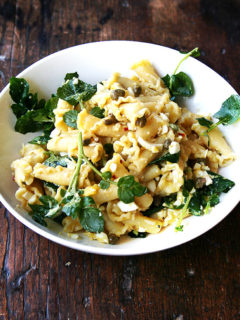
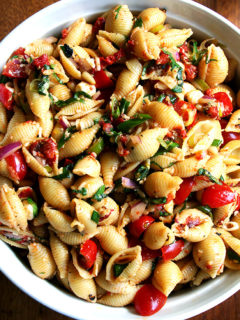
Simple Pasta Salad

Kristina's pasta salad

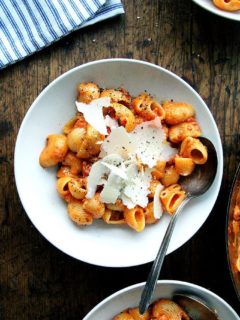
Many years ago, I traveled to the Cape with my aunt Marcy to see my Great Aunt Phyllis’ family. I don’t remember much of our short visit except that I returned home with the recipe for a pasta salad that we soon named after my cousin, Kristina, who had prepared the salad for us during our visit. That summer and for many summers that followed, we prepared this salad often — it’s particularly good warm, when the just-boiled shells melt the cheese, just slightly cook the tomatoes and soak up all the flavors of the olive oil and lemon juice.

Also, feel free to make adjustments based on your preferences: feta may have been used in place of mozzarella, sun-dried tomatoes in place of the roasted red peppers, etc. This salad can also be prepared ahead and served at room temperature — it tastes better the longer it sits in fact.

Kristina’s Pasta Salad
Serves 6 to 8 as a side

1 lb. shells
½ cup pine nuts
1 pint grape tomatoes
1 bunch scallions (finely diced red onion is nice, too)
3 roasted red peppers (or used jarred)
2 balls (large size) or a small tub of ciliegine mozzarella
1 bunch basil
extra-virgin olive oil
kosher salt
fresh cracked pepper
1 lemon, halved
freshly grated Parmigiano Reggiano

1. Bring a large pot of water to a boil. Add pasta and a large pinch of kosher salt. Cook about 8 minutes or until done but not mushy. Drain and set aside.

Meanwhile, place pine nuts in a small skillet over low heat. Toast, stirring often to avoid burning. Remove from heat when evenly golden brown. Set aside.

2. Cut grape tomatoes in half lengthwise. Remove ends from scallions and discard. Chop thinly, using mostly the white and pale green parts (some of the dark green is ok, too). Chop the roasted red peppers into small strips. Cut the mozzarella into cubes about the same size as the cherry tomatoes (or if you are using the ciliegine, use them whole or slice in half). Set aside.

3. Place pasta in a large bowl. Drizzle olive oil over pasta until nicely coated. Season with salt and pepper to taste. Add all of the prepared ingredients. Remove tiny leaves from basil stems and add directly to the bowl. Stack four to five larger basil leaves on top of one another. Roll into a tight spiral, then cut into thin strips. Add to the bowl. Squeeze the lemon over the top of the whole mixture starting with just one half. Add a few handfuls of the grated Parmigiano Reggiano. Toss gently with a large spoon. Taste, add more salt, pepper, olive oil or lemon juice if necessary.

Pumpkin Ravioli

Happy Belated Halloween! Well, this certainly won’t be the last pumpkin recipe of the season, but it’s the last for a few weeks at least. With Thanksgiving just weeks away, I have to admit I have been thinking a lot about pumpkin pie and pumpkin ice cream. Maybe that’s because I have a pecan pie sitting on my counter. I need to do something about that — I had a slice for breakfast. I wish I were kidding.

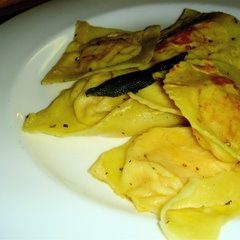
Anyway, I can’t pretend this recipe will take little effort. It might take all day actually. However, this recipe can be made over a few days: Roast the squash and make the filling one day; make the dough and shape the ravioli the next; cook them immediately or freeze them indefinitely. The sage brown butter sauce takes no time to prepare, so having these tasty pillows on hand (frozen) makes for a simple dinner.

And I guess they really can’t be called ravioli. I’m not sure what shape they are, but they’re yummy nonetheless.

Pumpkin Ravioli with Sage Brown-Butter Sauce

Filling:
1 sugar pumpkin*
olive oil
kosher salt and pepper
2 cups Parmigiano Reggiano, freshly grated
2 eggs, lightly beaten
*Winter squash such as Hubbard, red kuri or butternut make fine substitutes for the pumpkin. One sugar pumpkin yields about two cups of flesh.

Preheat the oven to 400ºF. Cut pumpkin in half, scoop out the seeds and discard. Drizzle about a teaspoon of olive oil on a baking sheet. Season inside of pumpkin with salt and place cut side down. Roast for about 45 minutes or until a knife inserts easily through the skin into the flesh. Remove from the oven and let cool completely.

Scoop out flesh and place in a bowl. Add the two cups of cheese and season with salt to taste. Mix to combine. Taste and add more salt until the mixture tastes well seasoned — there is no salt in the dough, so this is your only chance to season the ravioli. Add the eggs and mix to combine. Set aside

Dough:
3½ cups all-purpose flour, plus extra for kneading
5 large eggs lightly beaten

Mound flour in the center of a medium-sized bowl. Make a well in the center of the mound of flour. Add the eggs to the center. Using a fork, beat the eggs and begin to incorporate the flour, starting with the inner rim of the well. When the eggs are almost completely incorporated, start kneading the dough in the bowl and then transfer to a large, lightly floured wooden board and continue to knead for 10 minutes, dusting the board with additional flour as necessary. The dough should feel elastic and a little sticky. Wrap the dough in plastic wrap and allow to rest for 30 minutes at room temperature before using.

To Make:
4 T. unsalted butter
8 fresh sage leaves
¼ cup Parmigiano Reggiano

To make the ravioli, divide the dough into 4 pieces. Keep the dough covered with plastic wrap at all times. 
Lightly flour one of the pieces of dough, and shape into a rectangle about ½-inch thick.

Pass through the widest setting on a pasta machine. Fold the dough in three, like a letter, and pass through the same setting again feeding the short end in first. Repeat this step 2 times, adding flour as needed.

Without folding the dough now, repeatedly pass it through the machine rollers, reducing the space between the rollers after each pass. When it has passed through the thinnest setting, it is ready to be shaped into ravioli. (If the dough gets too long and difficult to deal with, cut it in half and feed each piece through separately until each has passed through the thinnest setting).

The dough should be just less than 6 inches wide. On the bottom half of the dough, place heaping teaspoons of the squash filling, evenly spaced every 1½ inches. Fold top half of dough over bottom half. With a knife or fluted roller, cut between each mound to create the individual raviolis. Gently pinch to seal the two dough layers together, using a tiny bit of water if necessary. Transfer to a baking sheet dusted with flour and cover with plastic wrap while you shape the remaining sections of dough.

At this point, decide how many ravioli you want to cook, and then freeze any remaining: Do not store ravioli in the refrigerator — they become a soggy mess.

To serve: Bring a large pot of water to a boil and add 1 tablespoon of salt. Place butter in a small sauté pan and heat until it bubbles. Add the sage leaves and let sizzle until crisp, about 1-2 minutes total. Turn off the heat, remove leaves with tongs and drain on a paper towel. Set aside. When water boils, add ravioli and cook until tender about 2-3 minutes (frozen ravioli also take only about 3 minutes). When ravioli are done, drain, or remove with a spider, but do not rinse under cold water. Place ravioli on a serving platter. Heat butter again until hot and begins to brown. Return the sage leaves and then spoon brown-butter over ravioli. Sprinkle with cheese. Serve immediately.

Mandy’s Spaghetti Sauce

For the past few weeks, I’ve neglected to bring my husband any of his favorite treats when I visit him. No brownies, no cookies, no granola, no power bars, no quick bread — no sweets at all, in fact, for my favorite Marine (who just graduated from The Basic School … yay!). And I hate to admit it, but if ever there were a time when he needed that extra brownie, it’s now.

Thanks to my sister-in-law, Mandy, however, a weight-lifting, football-watching, Gamecocks-cheering fireball from South Carolina, who gave me her spaghetti sauce recipe, I have been able to bring Ben Tupperwares filled with pasta and meat sauce. Mandy makes this recipe in bulk for a number of reasons: For one, with a six-month old running around — almost running around — she has little time to make dinner every night. Second, she doesn’t love to cook (although she’s a culinary whiz), so having this sauce on hand minimizes the time she spends in the kitchen. And lastly, she has to feed not only herself and baby every night, but also her professional-powerlifter husband, John. (John holds a world record in his weight class for a dead lift and squat combination score.)

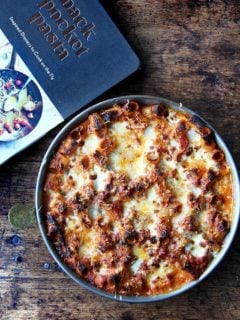
This recipe yields two quarts of sauce and freezes beatifully. For one pound of pasta — spaghetti, macaroni, shells or any other pasta variety — one quart of sauce works perfectly. With tons of fresh basil and a few shavings of Parmigiano Reggiano or Pecorino Romano, this spaghetti makes a wonderful dinner. Thanks Mandy!

Mandy’s Spaghetti Sauce
Yield = 2 quarts

2 teaspoons olive oil
2 lbs. ground beef
1 large onion, chopped
1 green bell pepper, chopped
1 clove garlic, chopped
2 (6-ounce) cans tomato paste
1 (8-ounce) can tomato sauce
1 (28-ounce) can chopped tomatoes
1 tablespoon Italian seasoning
1 tablespoon Worcestershire sauce
2 teaspoons sugar
1 teaspoon table salt

Heat the oil in a large heavy-bottomed pot. Add the meat and brown, stirring occasionally. Add the onion, green pepper, and garlic, and sauté until the onion is tender, about 5 minutes. Add the tomato paste, tomato sauce, chopped tomatoes, 1 cup water, and seasonings. Simmer for 30 minutes. Taste, add more salt or sugar if necessary, and serve over pasta immediately, or let cool until ready to serve.

Note: This sauce will keep for several days in the refrigerator or indefinitely in the freezer. For a simple healthy meal, cook whole-wheat spaghetti, add lots of chopped fresh basil and a few shavings of Parmigiano Reggiano or Pecorino Romano.

Korean Flank Steak and Chilled Soba

Korean Flank Steak

Most people go to Morimoto for sushi. For fatty tuna rolls and tuna belly sashimi, some aficionados will pay any price. Indeed, the sushi at this Stephen Starr, Iron Chef-run restaurant is arguably the best in the city.

I go to Morimoto, however, for something else. Morimoto’s cha-soba — chilled green tea soba noodles served with dashi-shoyu, a savory dipping sauce — cannot be found anywhere else in the city. Many sushi restaurants serve soba noodles, hot and cold, but few serve this green tea variety.

Cha-soba translates to tea-soba and describes the noodles, which are made with matcha (green tea powder) and buckwheat flour. Partly I enjoy the dish’s assembly — seaweed-green noodles nested on ice in a bamboo box arrive next to a bowl filled with the dashi-shoyu and a plate of sesame seeds, scallions and freshly grated wasabi — but mostly I love the chewy texture and distinct green tea flavor of the noodles.

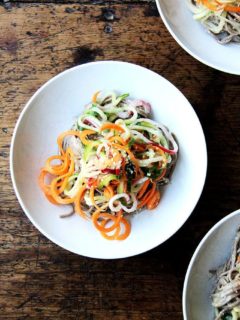
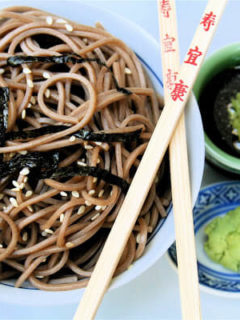
Chilled soba made with traditional buckwheat noodles:

Chef Masaharu Morimoto suggests, as communicated through his attentive servers, tasting the dashi, seasoning it with wasabi, dipping the noodles into the sauce and eating directly from the bowl. A combination of kombu (dried kelp seaweed) and bonito shavings (dried, flaked mackerel) steeped in mirin, soy sauce and water make the dashi, a flavorful and aromatic stock. Dipping the noodles, as opposed to dressing them, in a chilled broth spiked with fresh wasabi — a treat for any sushi lover — ensures a perfect ratio of sauce to noodle.

Ordered on its own, this dish, costing $12 a serving — although not the best deal for noodles in the city — makes a perfect summer lunch and when paired with sushi or grilled fish or steak, a side dish worth sharing at dinner. Cha-soba for me, like a toro-stuffed maki roll for most Morimoto patrons, induces a bliss matched by no other noodle-serving restaurant in the city.

And before I went green, I used to enjoy — adore — Morimoto’s kobe beef carpaccio: thin slices of delectable, tender meat, rubbed with ginger and garlic and seared with a hot sesame-olive oil mix. Now, however, I don’t know how I feel about kobe beef. Is it grass fed? I really don’t know enough about the treatment of kobe beef cows, but I do know that the grass-fed beef from Livengood Farm in Lancaster is delicious. All who enjoyed the grass-fed hamburgers for the Fourth of July can attest. This marinade for flank steak (grass-fed, purchased from Livengood’s at the South and Passyunk Farmers’ Market this past Tuesday) can also be used for skirt or hanger steak.

Like Morimoto’s carpaccio, this steak recipe has tons of ginger and garlic. The sugar in the marinade helps the meat char nicely on the grill and the soy sauce balances the sweetness. The Asian flavors in this Korean-style flank steak makes it a perfect entrée to serve with the chilled soba.

Grass-fed cows at the Livengood Family Farm in Lancaster, PA:

Korean-Style Flank Steak
Serves 4

¼ C. sugar
¼ C. + 2 T. soy sauce
1 T. + 1 tsp. mirin
6 large cloves garlic, minced
6 scallions, white part only, minced
1-inch knob fresh ginger, finely chopped
1 T. + 1 tsp. sesame oil
1½ lbs. flank steak
oil for greasing
kosher salt to taste

Whisk together the sugar, soy, mirin, garlic, scallions, ginger and sesame oil until smooth. Transfer to a resealable plastic storage container or a Ziploc bag. Place the meat and let marinate for 3 to 4 hours or overnight.

Preheat the grill to high. Remove steak from marinade and discard. If meat has marinated overnight, season it very lightly with salt or not at all . If meat has marinated for just a few hours, season lightly with salt. Grease the grill grates with oil.

For flank steak about 1-inch thick, grill four minutes on one side. Flip, grill three minutes on the other side for medium rare. Remove from heat and let rest 10 minutes before slicing across the grain.

Chilled Soba Noodles with Dashi-Shoyu
Adapted from Sally Schneider, A New Way To Cook, (Artisan, 2001)
Serves 6

½ oz. kombu (kelp seaweed)
2½ C. water
½ oz. dried bonito shavings
½ C. mirin
½ C. soy sauce or tamari
12 oz. soba noodles or green tea soba noodles
wasabi powder
1 bunch scallions, thinly sliced
sesame seeds
1 sheet nori, cut into thin strips

Place the kombu and the water in a small saucepan. Bring to a gentle simmer. After one minute, remove the kombu and discard. Remove the pan from the heat, add the bonito shavings and do not stir. When the bonito has sunk to the bottom, after a minute or two, strain the broth through a fine strainer, pressing on the bonito shavings with a spatula to extract all the liquid, then discard.

In a small saucepan, bring the mirin to a boil. Add the kombu broth and the soy sauce and simmer for 4 minutes. Remove from the heat, allow to cool, then refrigerate until chilled.

Bring a large pot of water to a boil. Add the noodles and cook until al dente, about 4 minutes. Drain and rinse under cold water or plunge into an ice bath. Drain and set aside.

When ready to serve, mix wasabi powder with water to make a paste and set aside. Place all of the garnishes — scallions, sessame seeds, nori and wasabi — in separate bowls. Divide the noodles among six plates. Pour the dashi-shoyu into 6 small bowls large enough to handle a serving of chosptick-filled noodles dipped inside, (much larger than what is pictured.) Give each diner a bowl of noodles and sauce and let them garnish their noodles as they please.

Zucchini Pappardelle

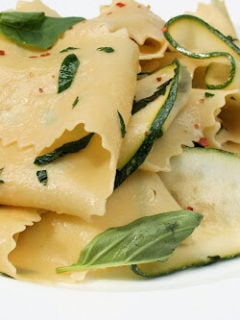
My favorite restaurant in Philadelphia is Melograno, a BYOB at 22 and Spruce. Every time I go I can’t help but order the pappardelle tartufate, a mix of homemade pasta, wild mushrooms, walnuts, Parmigianno Reggiano and truffle oil. I try to branch out, but ultimately never have the courage — I always give in when the waiter appears.

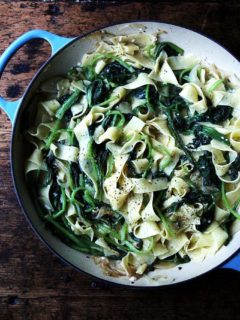
This recipe only resembles Melograno’s signature pasta by way of the shape of its noodles. I purchased a fluted roller at Fante’s and fresh, whole pasta sheets from Talluto’s on the Italian Market and cut the pasta into 2-inch wide strips. The noodles cook in three minutes and their heat instantly cooks the thin ribbons of zucchini when gently tossed. A recipe for linguini with julienned zucchini in Michael Chiarello’s Tra Vigne cookbook inspired this recipe. Tons of basil and parsley make this a perfect summer pasta.

Zucchini Pappardelle
Serves 4

¾ lb. fresh pappardelle* pasta
¾ lb. zucchini
kosher salt
pepper
¼ cup extra-virgin olive oil
2 T. minced garlic
½ teaspoon red pepper flakes
¼ cup chopped fresh basil
2 T. chopped parsley
½ cup grated Parmigiano Reggiano

Bring a large pot of water to a boil and add a big pinch of salt. Meanwhile, using a mandoline or peeler, cut the zucchini lengthwise into long thin ribbons about 1/8-inch thick. Set aside in a large serving bowl

Place the oil and the garlic in a large nonstick sauté pan and turn heat to medium. Heat only until garlic begins to sizzle. Add the pepper flakes and remove from the heat.

Eggplant, purslane and summer squash at the South and Passyunk Farmers’ Market:
Add the pasta to the water, and using tongs, gently move pasta around to make sure it is not sticking. Cook until al dente. Reserve ½ cup of the pasta cooking liquid. Drain pasta — do not rinse — and add to the bowl with zucchini. Return the sauté pan with the oil to a burner over medium heat and when the garlic begins to sizzle again, add the parsley and the basil and immediately pour over the pasta and zucchini. Add the Parmigiano, season with kosher salt and pepper to taste and toss gently. Taste, adding some of the reserved cooking water, more olive oil or more salt and pepper if necessary.

*Delicious fresh pasta sheets can be found at Taluto’s on the Italian Market. For a pretty presentation, purchase a fluted roller at Fante’s and cut the fresh pasta sheets into 2-inch-wide strips. Dried pappardelle works well also.

CSA Week 11

1 bunch Chiogga beets grown by Farmdale Organics
2 green peppers grown by Meadow Valley Organics
1 head red leaf lettuce grown by Scarecrow Hill Farm
3 candy onions grown by Back Forty Ranch
1 dozen ears of sweet corn grown by Green Acres Organics
6 tomatoes grown by Green Valley Organics and Countryside Organics
2 lemon cucumbers grown by Riverview Organics
1 bag green beans grown by Countryside Organics
2 green cucumbers grown by Farmdale Organics
2 green zucchini grown by Meadow Valley Organics
4 patty pan squash grown by Green Valley Organics
1 pint grape tomatoes grown by Farmdale Organics

Zucchini Bread

Although I picked up my 10th CSA today, I am still playing catch-up in my documentation of produce deliveries and am thus posting a recipe I made way back in week 4. While banana bread is probably my favorite quick bread, I look forward to making this zucchini bread every summer. Spiced with cinnamon and sweetened mostly with brown sugar, this moist seasonal bread makes a wonderful addition to breakfast coffee or afternoon tea all summer long. It takes no time to make and, when prepared in mini loaf loaf pans, makes a nice gift as well.

Week 4
1¼ pound bag of pea tendrils
1 head green butterhead lettuce
1 crown broccoli
2 small zucchini
1 bunch scallions
1 head green or red leaf lettuce
1 kohlrabi root
1 quart strawberries

Zucchini Bread
Yield: 1 large loaf or 3 mini loaves

a scant 2 cups (8 oz.) flour
¾ teaspoon baking powder
¾ teaspoon baking soda
1 tsp. cinnamon
1 tsp. kosher salt

1 cup light brown sugar
½ cup granulated sugar
¾ cup vegetable oil
1 teaspoon vanilla extract
2 eggs, lightly beaten
2½ cups grated zucchini

Preheat the oven to 350˚F. Grease loaf pan or pans. Whisk together first five ingredients. In a separate bowl, whisk remaining ingredients except zucchini. Add zucchini to the flour mixture and toss to coat. Add dry to wet and stir till until combined. Pour into pans. Bake until toothpick comes out clean, about 35 – 45 minutes for mini loaves, and 45 minutes to 1 hour for a standard loaf pan.

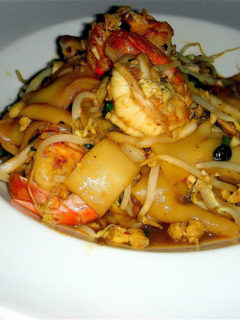
Rad Na Thai Shrimp

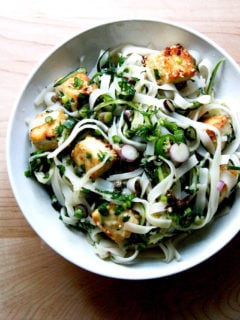
Every so often I find myself craving Continental’s Rad Na Thai Chicken. I was first introduced to this warm bowl of fresh rice noodles, bean sprouts, scallions, peanuts, chicken and slightly wilted romaine by a friend who described it as “a big bowl of goodness.” And that it is. You can imagine my excitement when I came across a recipe for this Continental staple in Aliza Green’s new cookbook, Starting with Ingredients. More exciting was discovering how easy the dish is to prepare—the sauce only has four ingredients—and once all of the ingredients are prepped, the dish takes fewer than ten minutes to complete. Here I’ve prepared the dish with shrimp but any cut of meat that can be quickly sautéed—thinly sliced chicken, pork or beef—can be easily substituted for the shrimp. Some of the ingredients, such as the fresh rice noodles, will have to be purchased at an Asian grocery store. My favorite is Hung Vuong Market at 11th and Washington (there is a link to the market in the sidebar). Look for the uncut fresh rice noodles that are packaged in clear plastic with red writing in the non-refrigerated section of the market.

Rad Na Thai Shrimp
Serves 3-4

Sauce:
6 tablespoons Chinese oyster sauce
3 tablespoons Asian fish sauce
3 tablespoons sugar
3 tablespoons rice wine vinegar

Combine all ingredients in a small pot and bring to the boil. Reduce heat and simmer 5 minutes. Cool before storing.
Keeps in the refrigerator for up to 1 week.

Rad Na:
2 tablespoons canola oil
1 pound shrimp 16/20 count, peeled and deveined, tails left intact
2 eggs, lightly beaten
1 pound fresh rice noodles, cut into 3/4-inch wide strips
1/2 teaspoon crushed red pepper flakes
Rad Na Sauce (see recipe above)
1 bunch scallions, thinly sliced
1/2 pound fresh mung bean sprouts
1 cup roasted salted peanuts
1 head romaine, outer leaves removed, cut into squares

Heat a skillet or wok until smoking hot. Add the oil and heat again until smoking. Add the shrimp and let cook on one side for about a minute and a half. Flip the shrimp, cook for another minute, and then transfer to a plate–the shrimp should still look slightly raw (they’ll continue cooking as they sit and they’ll finish cooking at the end when they are tossed with all of the hot ingredients). Let the oil heat up again, another 20 seconds or so, then add the eggs. Stir vigorously to break up the egg as they cook.

Add the noodles, crushed pepper, and Rad Na Sauce. Stir to combine and coat noodles. When noodles are hot and coated with the sauce, add most of the scallions, most of the sprouts, and most of the peanuts. Return the shrimp to the pan, stir well to combine and coat all of the ingredients with the sauce and remove from heat.

Divide the lettuce between 4 bowls. Top with the hot noodle mixture and garnish with the remaining scallions, bean sprouts, and peanuts. Serve immediately.

Butternut Squash Ravioli with Crispy Sage

A few weeks ago I was motivated to make homemade butternut squash ravioli with sage brown butter sauce. When I initially started shaping the pasta dough I started questioning why I had begun such a tedious process. The first few ravioli I shaped were irregular, soggy and just plain hideous. As I persevered, however, the shaping process became easier and I finally developed my own, relatively efficient system. I froze most of what I created and my husband and I were able to enjoy this classic combination of savory sage and sweet squash for a second time last night. If you can overcome the frustrating preliminary shaping trials, I think you will find that your hard work will more than reward you with a few delicious and elegant dinners.

Butternut Squash Ravioli
1 large butternut squash (about 1 lb)
kosher salt and freshly ground pepper
1/2 tsp. olive oil for the baking sheet
1 1/4 cups freshly grated Parmigiano Reggiano
2 eggs, lightly beaten

1 recipe pasta dough (see below)

2 T. unsalted butter
2 T. extra-virgin olive oil
8 fresh sage leaves

Preheat the oven to 375 degrees F. Cut the squash in half lengthwise and scoop out and discard the seeds. Lightly season the inside with salt and pepper, and place on a lightly oiled baking sheet. Bake for about 1 hour or until the flesh is knife-tender.
Remove from oven and let cool slightly. Scoop out flesh and pass through the fine disk of a food mill or purée in a food processor. Measure the purée, you should have about 2 cups (slightly more or less is fine). Stir in one cup of the grated Parmigiano. Add salt and pepper to taste. Keep testing the mixture until it tastes good to you–there is no salt in the dough, so correct the seasoning at this point. Stir in the eggs, and set aside. This mixture can be made 1-2 days in advance.

Pasta Dough

3 1/2 cups all-purpose flour, plus extra for kneading
5 large eggs lightly beaten

Mound flour in the center of a medium-sized bowl. Make a well in the center of the mound of flour. Add the eggs to the center. Using a fork, beat the eggs and begin to incorporate the flour, starting with the inner rim of the well. (If you are skilled at employing the “well” method on a large wooden board, go ahead and do that. I have never had much luck using a board–the eggs usually break through the mound and run all over the cutting board. I’ve found that the bowl helps contain “run-away” eggs.) When the eggs are almost completely incorporated, start kneading the dough in the bowl and then transfer to a large, lightly floured wooden board and continue to knead for 10 minutes, dusting the board with additional flour as necessary. The dough should feel elastic and a little sticky. Wrap the dough in plastic wrap and allow to rest for 30 minutes at room temperature before using.


To make the ravioli, divide the dough into 4 pieces. While you work with one section, keep the remaining dough covered with plastic wrap.
1. Lightly flour the section of dough you are working with and roughly shape into a rectangle about 1/2 inch thick.
2. Pass through the widest setting on a pasta machine. Fold the dough in three, like a letter and pass through the same setting again feeding the short end in first. Repeat this step 2 times, adding flour as needed.
3. Without folding the dough now, repeatedly pass it through the machine rollers, reducing the space between the rollers after each pass. When it has passed through the thinnest setting, it is ready to be shaped into ravioli. (If the dough gets too long and difficult to deal with, cut it in half and feed each piece through separately until each has passed through the thinnest setting).
4. The dough should be just less than 6 inches wide. Cut in half lengthwise. On one of these halves, place tablespoon-sized dollops of the squash filling evenly spaced about every 1 and 1/2 inches. Lay remaining half of dough atop the squash-dotted sheet of pasta. (This whole process will take some practice. I can almost guarantee you that your first batch will be ugly. Once you develop your own method, shaping the remaining dough will be much easier). With a knife, cut halfway between each mound to create the individual raviolis. Gently pinch to seal the two doughs together, using a tiny bit of water if necessary. Transfer to a baking sheet dusted with flour and cover with plastic wrap while you shape the remaining sections of dough.
Note: this recipe makes a lot. I recommend shaping all of the dough (you may have extra filling which you could freeze) and then freezing whatever extra ravioli you don’t cook immediately. Also, do not store ravioli in the refrigerator–they become a soggy mess. Cook immediately or freeze.

To finish the dish, bring a large pot of water to a boil and add 1 tablespoon of salt. Combine butter and olive oil in a large non-stick sauté pan and heat until almost smoking. Add sage leaves and let sizzle until crisp, about 1-2 minutes total. Remove leaves with slotted spoon and drain on paper towel. Set aside. When water boils, add ravioli and cook until tender about 2-3 minutes (frozen ravioli also take only about 3 minutes). Reserve 1/4 cup of the pasta cooking water. When ravioli are done, drain, but do not rinse under cold water. Heat butter and oil again until hot, add ravioli (be careful, it will splatter), add reserved cooking water, remaining 1/4 cup of cheese and reserved sage leaves. Serve immediately.