Category Archives: CSA

Warm Goat Cheese Salad and Morning Song Farm CSA

salad3

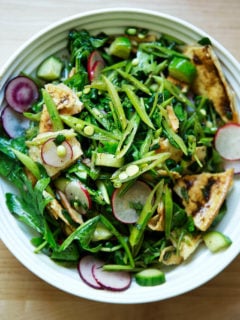
It’s hard to find fault in a warm round of herb-marinated, breadcrumb-encrusted goat cheese. But seriously my friends, the goat cheese was not the star of this salad. See those greens up there? The tender green leaves and the baby red romaine? These greens, gosh, I can’t even begin to tell you how delicious they are. They come from Morning Song Farm, the north San Diego County farm whose CSA I just joined.

I have been meaning to join a CSA since arriving in California over a year ago now, and when I learned that the new wine and cheese bar in town was a drop off spot for CSAs, I jumped. I signed up on a Monday via email and two days later my box of freshly harvested produce arrived at The Cellar. I can’t tell you how easy it was. Before I knew it, the above pictured greens were in my hands along with a boodle of other treats — lemons, avocados, grapefruits, Swiss Chard, beets, strawberries, herbs and the list goes on and on. (You can see almost everything that arrived in weeks one and two in the pictures below.)

Most of you know what a CSA is, but just in case, here is a quick summary. And if you still haven’t signed up for one, check out LocalHarvest.org. With 2,500 participating farms listed in their database, Local Harvest has the most comprehensive directory of CSAs in the country.

When I saw these greens, I thought of Alice Water’s recipe for baked goat cheese salad, which Cookstr recently highlighted in their Mother’s Day newsletter. And a good recipe it is indeed. I basically followed it, substituting toasted panko bread crumbs for the freshly made ones, a shortcut I’m sure Alice Waters would look down on, but alas, it worked. I also just made a simple dressing with olive oil, lemon juice, salt, pepper and a pinch of sugar. Here is the recipe I basically followed.

Anyway, yay!!, it’s Wednesday, which means it’s CSA pickup day. I hate to be sentimental, but one of the best parts about belonging to a CSA is actually belonging. I so look forward to walking up to The Cellar every Wednesday and saying hi to Dawn and Zoe, who have become my west coast incarnations of Sarah Cain, Emily Teel and Joanna Pernick, my friends at the Fair Food Farmstand whom I dearly miss. It is so much fun peaking inside the box each week, inspecting the goods, and sharing a strawberry or a few strands of the most fragrant and delectable mint you have ever seen. Seriously, it is a real joy.

And last, for those of you who live in the area, Delaney’s Artisan Food Market in Temecula is hosting a cooking contest. The grand prize is $1,000 as well as a professional product development package and a reserved space at Delaney’s Artisan Foods Market. Very cool. Check it out.

csa3

csa1

week2_csa

csa week 2

Red Lettuce

lettuce

babygreens

Click here for Alice Water’s recipe for Warm Goat Cheese Salad

Rosemary-Butternut Squash Bisque & Challah

In the beginning of the growing season, I promised to document each CSA I received. To say the least, I have been negligent, especially recently. For this soup, I think I used the contents of three separate CSAs. I definitely roasted two butternut squash and two delicata squash, and I swear I roasted a pumpkin too, but I can’t find any documentation of actually receiving a pumpkin — I’ve written down each week’s content, and pumpkin is no where to be found on my lists. Am I going crazy?

Anyway, this soup couldn’t be simpler to make, and the recipe really is just a guide. I set the oven to 400ºF or 450ºF, cut the squash in half, scooped out the seeds, placed the squash cut-side down, and roasted them until they were tender (maybe 45 minutes or an hour). Once cooled, I scooped out the flesh, combined it all in a bowl, froze 2 cups of the mix for a later use (maybe ravioli filling) and added the rest (about 2 quarts) to a pot. I filled the pot with chicken stock, added salt, pepper and chopped rosemary, and simmered it for 30 minutes. I used my emersion blender to purée the mix, and in no time I had made a delectable soup.

The recipe called for orange zest, which I didn’t have and so didn’t use, but I remember it being a nice flavor when my mother used to make this soup for us. The recipe also calls for cream — which I guess justifies the title, though I would hardly call this purée a bisque — which I also didn’t use.

I happened to have some frozen challah on hand that I had made for a Rosh Hashanah article I was writing about Fork’s baker, Lauren Derstine, and it turned out to be a nice dipping bread, though any bread will do. Little Lindis and Mr. T. are heating up a bowl of this soup as I write…they can be the judges.

Rosemary-Butternut Squash Soup
Yield = 2 quarts

2 medium butternut squash
olive oil
6 cups chicken broth, preferably homemade
1 tablespoon chopped fresh rosemary
2 teaspoons grated orange zest
kosher salt and pepper to taste
2 tablespoons heavy cream, optional

Preheat the oven to 375ºF. Cut the squash in half lengthwise, scoop out the seeds and discard. Drizzle a teaspoon of olive oil on the baking sheet. Place the halves cut side down, rub in the oil and place in the oven. Roast until knife tender, about 45 minutes. Remove squash from the oven and let cool.

Scoop the flesh into a saucepan (discarding the skin), and add the broth, rosemary, orange zest, a big pinch of kosher salt and pepper to taste. Bring to a boil, reduce heat, and let simmer for 30 minutes. Using an emersion blender, puree the mixture until smooth. Alternatively, transfer to a food processor or blender, and puree until smooth. Taste, adjust seasoning if necessary and adding the cream if desired. Serve with crusty bread.

Measuring ingredients with a weight scale, just as professional bakers do, will more accurately reproduce this recipe than will volume measurers. While more accurate than digital scales, mechanical scales are expensive, take up space and are perhaps unnecessary for the home baker. Salter brand makes several good, reasonably priced, easy-to-store scales available at Fante’s, Kitchen Kapers and Williams Sonoma. For normal baking, a six to nine pound capacity will suffice.

Challah
Adapted from Peter Reinhart’s The Bread Baker’s Apprentice (Ten Speed Press, 2001)
Yield = 1 large loaf

4 cups (18 oz.) unbleached bread flour
¼ cup (2 oz.) granulated sugar
1 teaspoon (.25 ounce) salt
1 1/3 teaspoons (.15 ounce) instant yeast
2 tablespoons (1 oz.) vegetable oil
2 large eggs, lightly beaten
2 egg yolks, (whites reserved) lightly beaten
¾ cup plus 2 T. water
sesame or poppy seeds for garnish (optional)

Whisk together the flour, sugar, salt and yeast in the bowl of a stand mixer. In a separate bowl, whisk together the oil, eggs, yolks and water. Pour the liquid mixture into the flour mixture. Mix on medium-low speed for six minutes using the dough hook, adding a touch more flour if necessary — dough should gather round the hook (not be stuck to the bottom of the bowl), but be careful not to add to much additional flour. (Alternatively, knead on a lightly floured work surface for 10 minutes. While this method works fine, using a mixer helps prevent adding too much additional flour to the dough.)

When dough is soft and supple (not sticky), transfer the dough to a lightly oiled bowl, rolling the dough to coat. Cover the bowl with plastic wrap and leave to rise for one hour.

Remove the dough from the bowl, knead for two minutes to degas. Shape the dough into a ball, return it to the bowl, cover with plastic wrap and let rise again for another hour, or until the dough has doubled in bulk.

Remove the dough from the bowl and divide into three equal pieces. (If using a scale, weigh each portion.) Roll each portion into a ball, place on a work surface, and let rest 10 minutes.

Roll the pieces into long strands, each the same length, each with tapered ends and a slightly thicker center portion. Braid the dough starting from the middle: On a work surface, place the three strands perpendicular to you and parallel to one another. From the left, number the strands 1, 2, 3. Beginning in the middle of the loaf and working toward you, follow this pattern: right outside strand over the middle strand (3 over 2); left outside strand over the middle (1 over 2). Repeat until you reach the bottom end of the dough. Pinch the end closed to seal and rotate the dough 180º so that the unbraided end is facing you. Continue braiding but now weave the outside strand under the middle strand until you reach the end of the loaf. Pinch together the ends to seal.

Line a sheet pan with parchment paper and transfer the loaf to the pan. Beat the reserved egg whites until foamy and brush the dough with them. (Set aside whites for later.) Mist the loaf lightly with spray oil and cover loosely with plastic wrap. Let the dough rest at room temperature until it is one-and-a-half times its original size, about 60 to 75 minutes.

Preheat the oven to 350ºF with the rack in the middle shelf. Brush again with the egg whites, and if desired, sprinkle with sesame seeds. Bake for 20 minutes. Rotate the pan 180º and continue baking for another 20 minutes, or longer. The bread should be a rich golden brown.

Transfer to a cooling rack and let cool at least one hour before slicing.

Oven-dried Tomato Bruschetta

I must give credit to the Fair Food Farmstand again for providing another excellent recipe in their weekly email. A few weeks ago, after receiving eight Roma tomatoes (among many other treats) in my CSA, I opened my email to find Ann Karlen’s “tried and true” recipe for oven-dried tomatoes, just the guidance I needed to preserve these seasonal gems.

The recipe required six to eight hours of cooking, so I set the oven to 200ºF, as instructed, placed the prepared tray of tomatoes inside, and went to bed. I could not believe my eyes when I opened the oven door the following morning: The plump, juicy tomatoes had shriveled into desiccated, flat disks. Seeing the dehydrated tomatoes reminded me of lifting the towel from the bowl holding the first batch of bread dough I had mixed and kneaded on my own: Doubled in bulk, seemingly alive, the dough — the transformation of the dough — inspired true amazement.

I had to try one right away. To my surprise, this withered red package tasted incredible! Unable to resist storing my homemade “sun-dried tomatoes” — my intention when I set out to make them — I assembled a little bruschetta. On a toasted baguette from Metropolitan Bakery, topped with a slice of mozzarella from Claudio’s and a basil leaf from the farmstand, these tomatoes make a delectable appetizer — the most adored tastes of summer concentrated in one bite.

Oven-Dried Tomato Bruschetta
Serves 6 as an appetizer

12 plum tomatoes
kosher salt

1 baguette
olive oil
fresh mozzarella, cut into ½-inch thick slices
fresh basil

Preheat oven to 200ºF.
Halve each tomato lengthwise through the stem. Arrange the tomatoes, cut side up, side by side on a rimmed cookie sheet. (Tomatoes should not be touching one another.) Sprinkle each tomato lightly with salt.

Place in the oven and bake for six to eight hours, or until tomatoes are shriveled, but not dry and brittle. Check every couple of hours. (The tomatoes should still feel flexible when removed from the oven.) Remove tomatoes from the oven, and let cool completely before storing. Store in a glass jar or Ziploc. Moisten with olive oil if tomatoes are too dry. The tomatoes will keep indefinitely.

For the bruschetta, preheat the oven to 400ºF. Slice the baguette into ¾-inch thick rounds, drizzle with olive oil and bake until golden, about 10 minutes. Remove from the oven and let cool. Top each baguette slice with a piece of mozzarella, a few oven dried tomatoes and a few small leaves of basil. Serve.

Watermelon Gazpacho & Watermelon Salad

Last month for two weeks in a row, I received watermelons in my CSA. Though they were small, I hesitated from cracking into them, fearing I wouldn’t finish them on my own. So I let them sit for a few days until I received a fortuitous email from the Fair Food Farmstand. Emily Teel, the manager, sends an email each week listing the products the stand has in stock along with some seasonal recipes. When I saw the recipe for watermelon gazpacho, I set to work in the kitchen. Before too long, I had found a wonderful use for my two sugar baby watermelons, and produced a most delectable soup that I enjoyed, with the help of my sister, for the next few days.

While my sister and I slurped this minty, refreshing soup straight from the Tupperware containers I had packed it in, this gazpacho really deserves a more honorable presentation: The combination of colorful vegetables of all shapes and textures floating in a magenta base is truly striking. Served with a wedge of avocado and a sprig of mint in delicate bowls, this simple chilled soup makes an elegant summer meal.

Also, check out my latest entry on Uwishunu about Nam Phuong, a great Vietnamese restaurant at 11th and Washington.

When I first saw feta paired with watermelon, I thought the combination seemed odd, and truthfully, not that appetizing. My mother and I have been trying to remember where we first saw the duo — possibly a Jean Georges or Todd English cookbook, but we’re not quite sure. In any case, sweet and salty ingredients, hardly a novel concept, often work nicely together, watermelon and feta being one example. Only a few more weeks of watermelon season remain, so enjoy them while you can!

Watermelon Gazpacho
From Emily Teel, manager of the Fair Food Farmstand

3 pounds of watermelon flesh, diced (about 5 cups), divided
1 small cucumber, peeled, seeded, diced (about 1 cup)
1 red bell pepper, seeded, diced (about 1 cup)
1 pint yellow cherry or sungold tomatoes, quartered (about 1 cup)
1 small jalapeño chile, seeded, minced
3 pale green inner celery stalks, diced (about ½ cup)
½ small red onion, diced (about 1 cup)
3 tablespoons fresh lime juice
2 tablespoons red wine vinegar
¼ teaspoon salt
5-8 mint leaves, finely chopped
avocado for garnish

Puree 4 cups watermelon in blender until smooth. Transfer puree to large bowl. Add remaining 1 cup diced watermelon and next 10 ingredients; stir to combine. Cover gazpacho and refrigerate until cold, at least 1 hour and up to 4 hours.

Divide gazpacho among bowls. Top each with a slice of avocado.

Watermelon and Feta Salad
Serves 1

4 slices watermelon
2 ounces feta cheese
2 slices Prosciutto di Parma
extra-virgin olive oil
aged balsamic vinegar or reduced balsamic (see recipe below)
kosher salt and pepper to taste

Place watermelon wedges on a plate. Crumble feta cheese over the watermelon. Lay the prosciutto aside the watermelon. Drizzle entire plate with olive oil, balsamic, salt and pepper to taste.

Reduced Balsamic
Yield = ¼ cup

½ cup Rainwater Madeira
1 cup commercial balsamic vinegar
1 tablespoon brown sugar

Place Madeira in a small saucepan and simmer over medium heat until reduced to about 1 tablespoon. Add the balsamic vinegar and boil until the vinegar has reduced to about ¼ cup and is very syrupy and big shiny bubbles are forming at the surface. Watch the mixture very closely at this point—it will burn easily. Remove from the heat and stir in the brown sugar until dissolved. Pour into a clean jar and cool before using.

Zucchini Pappardelle

My favorite restaurant in Philadelphia is Melograno, a BYOB at 22 and Spruce. Every time I go I can’t help but order the pappardelle tartufate, a mix of homemade pasta, wild mushrooms, walnuts, Parmigianno Reggiano and truffle oil. I try to branch out, but ultimately never have the courage — I always give in when the waiter appears.

This recipe only resembles Melograno’s signature pasta by way of the shape of its noodles. I purchased a fluted roller at Fante’s and fresh, whole pasta sheets from Talluto’s on the Italian Market and cut the pasta into 2-inch wide strips. The noodles cook in three minutes and their heat instantly cooks the thin ribbons of zucchini when gently tossed. A recipe for linguini with julienned zucchini in Michael Chiarello’s Tra Vigne cookbook inspired this recipe. Tons of basil and parsley make this a perfect summer pasta.

Zucchini Pappardelle
Serves 4

¾ lb. fresh pappardelle* pasta
¾ lb. zucchini
kosher salt
pepper
¼ cup extra-virgin olive oil
2 T. minced garlic
½ teaspoon red pepper flakes
¼ cup chopped fresh basil
2 T. chopped parsley
½ cup grated Parmigiano Reggiano

Bring a large pot of water to a boil and add a big pinch of salt. Meanwhile, using a mandoline or peeler, cut the zucchini lengthwise into long thin ribbons about 1/8-inch thick. Set aside in a large serving bowl

Place the oil and the garlic in a large nonstick sauté pan and turn heat to medium. Heat only until garlic begins to sizzle. Add the pepper flakes and remove from the heat.

Eggplant, purslane and summer squash at the South and Passyunk Farmers’ Market:
Add the pasta to the water, and using tongs, gently move pasta around to make sure it is not sticking. Cook until al dente. Reserve ½ cup of the pasta cooking liquid. Drain pasta — do not rinse — and add to the bowl with zucchini. Return the sauté pan with the oil to a burner over medium heat and when the garlic begins to sizzle again, add the parsley and the basil and immediately pour over the pasta and zucchini. Add the Parmigiano, season with kosher salt and pepper to taste and toss gently. Taste, adding some of the reserved cooking water, more olive oil or more salt and pepper if necessary.

*Delicious fresh pasta sheets can be found at Taluto’s on the Italian Market. For a pretty presentation, purchase a fluted roller at Fante’s and cut the fresh pasta sheets into 2-inch-wide strips. Dried pappardelle works well also.

CSA Week 11

1 bunch Chiogga beets grown by Farmdale Organics
2 green peppers grown by Meadow Valley Organics
1 head red leaf lettuce grown by Scarecrow Hill Farm
3 candy onions grown by Back Forty Ranch
1 dozen ears of sweet corn grown by Green Acres Organics
6 tomatoes grown by Green Valley Organics and Countryside Organics
2 lemon cucumbers grown by Riverview Organics
1 bag green beans grown by Countryside Organics
2 green cucumbers grown by Farmdale Organics
2 green zucchini grown by Meadow Valley Organics
4 patty pan squash grown by Green Valley Organics
1 pint grape tomatoes grown by Farmdale Organics

Summer Squash Tart

Frozen puff pastry is amazing. I finally found a use for the box I’ve had in my freezer for three years now — the box that survived a move across town in 2005 — and it baked off perfectly. This tart requires a fair amount of summer squash — a perfect showcasing of the season’s produce — and takes little time to prepare with puff pastry on hand.This recipe has been slightly simplified from one I saw recently in Saveur, which called for grating, salting and sauteeing some of the zucchini, and also called for chopped and strained cherry tomatoes. With a simple salad, this tart, served at room temperature as suggested by the author, makes a wonderful summer dinner, and leftovers make an even better lunch.

Summer Squash Tart with Ricotta and Feta
Serves 6

1 10” x 13” sheet frozen puff pastry, thawed
parchment paper
pie weights or dried beans wrapped in plastic
1 tablespoon of olive oil
1 small onion, thinly sliced
kosher salt and pepper to taste
2 lbs. mix of zucchini and yellow squash
½ cup fresh ricotta
1 egg, lightly beaten
1 bunch parsley, finely chopped
1 tablespoon butter, melted
¼ cup feta cheese

Preheat the oven to 350ºF. Place pastry on a parchment-lined rimmed baking sheet. With a paring knife, gently score (being careful not to go all the way through) the pastry about one inch from the edge on all sides. Prick bottom of pastry all over with a fork, line center area only with parchment paper and fill with pie weights or beans. Bake for 20 minutes or until the edges are golden. Remove pan from oven and place on a cooling rack. Remove weights and parchment paper.

Meanwhile, heat the oil over medium heat and add the onion. Season with salt and pepper and let sauté until slightly caramelized about 6 to 8 minutes. Remove from heat to cool.

Zucchini and yellow squash at the South and Passyunk Farmers’ Market this past Tuesday:
Fill a medium saucepan with water and bring to a boil. Cut the squash crosswise into ¼ – inch thick rounds. Add to the pot of boiling water, cook for 30 – 60 seconds, drain and let dry on a paper-towel lined cookie tray.

In a small bowl, whisk together the ricotta, egg and parsley. Season with salt and pepper to taste and spread onto puff pastry. Top with the onions. Arrange squash pieces in overlapping rows until tart is filled. Bake for 15 minutes. Remove from oven, brush with butter and return to the oven for five minutes longer. Remove pan from oven, sprinkle with feta, and let cool for 10 minutes before serving.

CSA Week 10

1 bunch of beets grown by Farmdale Organics
2 green peppers grown by Meadow Valley Organics
3 Cubanella peppers grown by Green Valley Organics
1 head lettuce grown by Scarecrow Hill Farm
1 Walla Walla onion grown by the Scarecrow Hill Farm
1 dozen ears of sweet corn grown by Green Acres Organics
1 bag of potatoes grown by Green Valley Organic
2 lemon cucumbers grown by Riverview Organics
1 bag green beans grown by Hillside Organics

Zucchini Bread

Although I picked up my 10th CSA today, I am still playing catch-up in my documentation of produce deliveries and am thus posting a recipe I made way back in week 4. While banana bread is probably my favorite quick bread, I look forward to making this zucchini bread every summer. Spiced with cinnamon and sweetened mostly with brown sugar, this moist seasonal bread makes a wonderful addition to breakfast coffee or afternoon tea all summer long. It takes no time to make and, when prepared in mini loaf loaf pans, makes a nice gift as well.

Week 4
1¼ pound bag of pea tendrils
1 head green butterhead lettuce
1 crown broccoli
2 small zucchini
1 bunch scallions
1 head green or red leaf lettuce
1 kohlrabi root
1 quart strawberries

Zucchini Bread
Yield: 1 large loaf or 3 mini loaves

a scant 2 cups (8 oz.) flour
¾ teaspoon baking powder
¾ teaspoon baking soda
1 tsp. cinnamon
1 tsp. kosher salt

1 cup light brown sugar
½ cup granulated sugar
¾ cup vegetable oil
1 teaspoon vanilla extract
2 eggs, lightly beaten
2½ cups grated zucchini

Preheat the oven to 350˚F. Grease loaf pan or pans. Whisk together first five ingredients. In a separate bowl, whisk remaining ingredients except zucchini. Add zucchini to the flour mixture and toss to coat. Add dry to wet and stir till until combined. Pour into pans. Bake until toothpick comes out clean, about 35 – 45 minutes for mini loaves, and 45 minutes to 1 hour for a standard loaf pan.

Three Summer Salads

Before I received my first CSA produce box this spring, I resolved to document each delivery. Alas, now in week nine, I’ve only recorded the contents of three boxes, and have not posted nearly as many recipes as I had hope. I have, however, been truly enjoying my vegetables each week, the variety and quantity forcing me, at times, to be creative: I fix cucumber and kohlrabi sandwiches for lunch; eat zucchini, raw, thinly shaved with lemon vinaigrette and Pecorino Romano; and when in the company of my sister, enjoy corn — only corn — for dinner: just yesterday we polished off a dozen ears together. Below are recipes for three summer salads, each requiring the dressing of a simple lemon vinaigrette.

CSA Week 9
3 green zucchini
3 yellow squash
2 stalks fennel
2 bunches Detroit red beets
1 dozen ears of sweet corn
2 candy onions
3 tomatoes
2 heads lettuce
1 bag green beans

Zucchini Ribbon Salad
Serves 4

2 medium zucchini
Lemon Vinaigrette (recipe below)
Pecorino Romano
Freshly ground pepper to taste

With a y-shaped peeler, skim long, wide strands from one side of the zucchini. Flip the zucchini over and repeat the same motion until the zucchini no longer can hold its shape. (Discard remaining, or save for another use, such as zucchini bread.) Place zucchini ribbons in a large bowl and drizzle with lemon vinaigrette to coat. Shave, using the same y-shaped peeler, pieces of Pecorino and set aside. Season zucchini with freshly ground pepper and toss in the Pecorino shavings. Serve immediately.

Grilled Panzanella Salad
Serves 4

1 loaf bakery-style bread such as French or Italian
extra-virgin olive oil
2 beefsteak tomatoes
1 cucumber
½ red onion
½ cup ciligene mozzarella (small balls)
Lemon Vinaigrette
1 bunch basil

Preheat the grill to high. Cut four ¾-inch thick slices of bread and brush each side with olive oil. Grill for 1-2 minutes a side, until each side has nice grill marks. Transfer to a cooling rack.

Cut the tomatoes into big, irregular-shaped chunks. Peel cucumber, if desired, and cut into similar shapes. Finely dice the red onion and place in a large bowl with the tomatoes, cucumber and mozzarella. Drizzle in the lemon vinaigrette until everything is nicely coated. Tear basil leaves from their stems (leaving the leaf intact) directly into bowl.

Cut the grilled bread into cubes and add to the bowl. Toss to combine and serve.

Cucumber-Feta Salad
Serves 4

2 medium cucumbers
1 bunch mint
4 oz. feta cheese*
Lemon vinaigrette

Cut cucumber into small cubes and place in a large bowl. Chiffonade (very finely mince) the mint and add to bowl. Crumble feta atop cucumber-mint mix and toss salad with the lemon vinaigrette.

* Earlier this week at Whole Foods I discovered a tub of marinated feta, beautifully packaged and stamped with an enticing slogan: “Eat shamelessly straight from the tub,” — I couldn’t resist. Produced by Meredith Dairy in Australia, this sheep’s- and goat’s-milk cheese, has a creamy texture and wonderful flavor — the hints of thyme, peppercorns and garlic perfectly detectable. While this farmhouse feta truly is a treat, any will suffice in this simple summer salad.

CSA Week 8
1 lemon cucumber
2 dasher cucumbers
1 bunch dandelion greens
1 candy onion
1 head radicchio
1 head lettuce
1 bag green beans
1 dozen ears sweet corn
1 bag potatoes
1 bag yellow squash

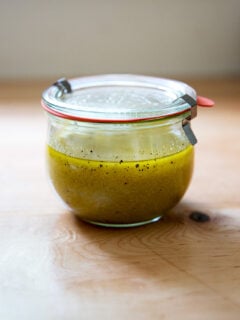
Lemon Vinaigrette
Yield = 1 cup

¼ cup finely chopped shallots
¼ cup lemon juice
½ tsp. kosher salt
¼ tsp. sugar
freshly ground black pepper to taste
½ cup extra-virgin olive oil

Whisk shallots, lemon juice, salt, sugar and pepper. Slowly drizzle in the oil and whisk until emulsified. Transfer to a jar and refrigerate until ready to use.

Almond Scones with Strawberry Jam

So many goodies arrived today in my CSA basket, but most notably, a jar of homemade strawberry jam from Countryside Produce in Paradise, PA. Last week we received a quart of strawberries, this week jam — heaven! Sadly, we may already have reached the peak of strawberry season: This past Tuesday, at the South and Passyunk Farmers’ Market, Gloria from the Rineer Family Farmstand doubted she would bring any more strawberries this summer. Although I will miss the fresh strawberries, I will happily savor this jam. For a wonderfully sweet breakfast, serve the jam with these buttermilk-almond scones.


CSA Week 5:
1¼ lbs sugar peas
1 head cabbage
1 crown broccoli
3 zucchini
1 bunch scallions
1 head green leaf lettuce
1 head red leaf lettuce
1 kohlrabi root
1 bunch cilantro
1 bunch garlic scapes
1½ lbs kale

Almond-Buttermilk Scones
Yield=6

a scant 2¼ cups (10 oz.) all-purpose flour
¼ cup plus 1 tablespoon (2.33 oz) sugar
1½ teaspoon baking powder
¼ teaspoon baking soda
½ teaspoon kosher salt
1 cup sliced almonds
2/3 cup buttermilk
1 teaspoon vanilla extract
1 stick cold unsalted butter

2 tablespoons milk
turbinado or demera sugar for sprinkling

Set oven to 375°F.
In a medium to large-sized mixing bowl whisk together the flour, sugar, baking powder, baking soda and salt. Add the almonds and stir to combine. In a small bowl, whisk together the buttermilk and the vanilla. Cut the cold butter into the flour mixture and stir to combine. Add the buttermilk mixture to the flour mixture and stir to combine. Gently knead the dough together in the bowl until it is just combined. Be careful, however, not to mix and knead the dough too much—you just want to combine the ingredients. If you have to add a tablespoon more of buttermilk, do so, but otherwise just gently pack the mixture into a ball and then turn dough out onto a work surface.

Gently pat and shape the dough into a rectangle approximately ¾ to 1 – inch thick. With a knife or bench scraper, cut the dough into six triangles. At this point, either freeze the cut scones in a zip lock bag or place them on Silpat or parchment paper-lined cookie sheet.

Brush the scones with the milk and sprinkle with the sugar. (Note: you can brush the scones with anything you like: eggs, egg whites, cream, even water. If you don’t have turbinado or demera sugar, regular granulated sugar is a fine substitute.) Bake the scones for approximately 15-18 minutes. (When you bake frozen scones, remove them from freezer while oven preheats. Brush with wash just before baking and bake 18-23 minutes.) Serve immediately with strawberry jam.

Unfortunately, as of now, I have no recipe for strawberry jam, but will post one as soon as I find one. These and the strawberries above are from the Rineer Family Farmstand.