CSA

Quinoa with Walnuts, Radishes & Spring Onions • How to Cook Quinoa Properly • Fair Trade Quinoa

quinoa salad

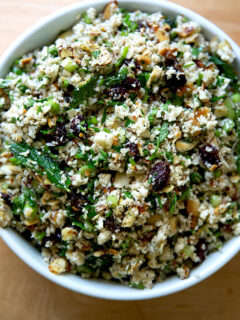
A few weeks ago I discovered that for all the years I have been cooking quinoa I have been doing it wrong. The quinoa I have made, as a result, while edible and receptive to countless seasonings and additions, has never kept my attention for very long — after the odd week-long-quinoa binge, I’d forget about it for months.

But after posting the radish entry a few weeks ago, I received a comment from a dear old friend who managed several of the Philadelphia farmers’ markets while I lived there. Joanna pointed me to a Yotam Ottolenghi recipe for a quinoa salad with radishes, fava beans, avocado and a lemon vinaigrette she had recently made for some friends to rave reviews.

A quick google search led me to the recipe. While the ingredient list had me foaming at the mouth, it was the first few lines of the instructions that really struck me: Place the quinoa in a saucepan filled with plenty of boiling water and simmer for 9 minutes. Drain in a fine sieve, rinse under cold water and leave to dry.

PLENTY of boiling water. Simmer for NINE minutes. RINSE under cold water. Is this news to you, too? Why has every package of quinoa instructed me to cook it as if it were rice — 1 part grain to 2 parts water — in a covered pot? And to cook it for at least 15 minutes but often for as long as 20? And after the cooking process, to let it rest off the heat under its steaming lid for an additional 5 to 10 minutes?

Read More

Paul Steindler’s Cabbage Soup and A Peasant Bread Follow-Up

cabbage soup

When I’m home in CT visiting my parents, my favorite pastime is poking around the two basement refrigerators, the home of all sorts of treats my mother has been preparing — soups, spanakopita, Grand Marnier chocolate truffles — and stocking up on — smoked mussels, white anchovies, enough cheeses to feed the neighborhood — for weeks. It’s a little gourmet paradise inside those boxes, and it’s impossible not to sneak a peak (and a truffle) with every trip down to the basement.

The only hard part about being home for the holidays is refraining from eating all day long. From the first bite of homemade cinnamon oatmeal bread in the morning to the last bite of flourless chocolate-almond torte in the evening, my stomach barely gets a rest. There is goodness at every turn, and none so much (if you ask me) as at lunch, which hasn’t changed (during the holidays at least) in about a decade: a bowl of soup, a square of spanakopita and a slice or two of homemade bread. On this most recent visit, we feasted on Vermont cheddar cheese soup — my favorite — and rosemary butternut squash bisque with slices of toasted buttered rye bread on the side. It was heaven.

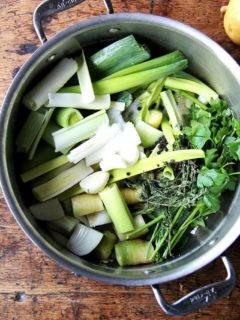
Five days of this soup-and-bread routine made me miss it dearly upon returning home to my all-but-bare refrigerator. But when a large head of cabbage and a few carrots sitting in my vegetable drawer caught my eye, my spirits lifted. With the exception of fresh dill, I had everything on hand to make another favorite soup of my mother’s, one she has been making since the early 80′s: Paul Steindler’s cabbage soup with caraway seeds, a recipe Craig Claiborne wrote about many years ago in The New York Times Magazine and eventually published in The Essential New York Times Cookbook. Loaded with vegetables — carrots, potatoes, onions and cabbage — a little bacon and a touch of cream, this is definitely a hearty soup, best served on a cold winter day with crusty bread and nothing more. For me, it’s the dill and caraway seeds that make it unlike any other I have tasted, the caraway seeds in particular imparting a lovely yet subtle flavor. Read More

Big Apple Pancake

dusted with powdered sugar

I posted this recipe to Facebook over the weekend, so I’ll keep this brief. I have made this big apple pancake two weekends in a row now, and I have a feeling the run will continue for the remainder of the fall. It is one of the most fun recipes to prepare as it comes together in just minutes, puffs dramatically in the oven, and feeds four comfortably (so long as you provide some bacon or sausage on the side.)

This past weekend’s pancake came out better than the first, namely because I followed the instructions and made the effort to pulse the flour-egg-milk mixture in the food processor rather than just whisk by hand, which left the batter extremely lumpy. I also doubled the amount of apple this time around, ensuring that loads of tender apple slices filled every bite.

I love this recipe, but I find the name to be a bit of a misnomer — it tastes nothing like a pancake to me, leaving my pancake-making woes to persist. Alas, with a new delicious addition to the morning repertoire, I have no complaints. Hope you all had a nice weekend. Read More

Super Fast Pasta Dish: Rotini with Butternut-Sage Sauce

pasta with butternut squash sauce

Every so often all of my recipe hoarding proves worthwhile. A couple of nights ago, while fishing through my pasta file, pulling out every gnocchi recipe I have saved over the past decade, I found a recipe — penne with butternut-sage sauce — from a November 2006 Gourmet. Over the past six years, I have thought about this recipe often, as I do most of the recipes I tuck away, but especially this time of year when the butternut squashes and bundles of sage start arriving in my CSA.

I suspected this sauce would be good — the pairing of squash and sage rarely disappoints — but I didn’t imagine loving it as much as I did. It seemed too simple. But somehow the sauce, made with only butter, sage, squash, onion and water, tastes almost cheesy or as if it were made with cream or stock or something to provide richness. The butter, of course, adds considerable flavor, and the amount of butter, though I haven’t tested it, probably could be scaled back. But if you’re not afraid, just go for it. Adults and children (who likely will think it’s mac n’ cheese) alike will gobble it up. It’s a perfect dish for this time of year. Read More

Dinner in 30 minutes: Whole Grilled Trout, Steamed Green Beans, Brown Butter Orzo “Risotto”

trout meat

All I want when I’m old and gray is to live steps from a bakery like Tartine, a short drive from some good ethnic food, and a bike ride, perhaps, from a good fish market. Presently, I’m striking out on all three fronts.

A nice fish market, in particular, would be a most welcome addition to my current neighborhood. Discovering this past summer that places like Dockside actually exist, made me want to pack up and skip town permanently. It’s just that when fish is that fresh — literally caught off the dock — it needs so little attention to get from the fridge to the dinner table. And when fish that fresh is grilled whole, and the skin crisps, and the meat flakes off the tiny delicate skeleton, tasting not a bit dry or fishy just fresh and delicious, never am I happier.

A recent discovery — that Wegman’s sells whole rainbow trout — will likely keep me put for the time being. Farmed rainbow trout, because it is raised in an ecologically responsible way, makes it a Seafood Watch “best choice”. What’s more, whole rainbow trout is affordable. At $6.49/lb, two whole trout, which will feed three comfortably, cost $11.49. Fresh, sustainable, affordable, delectable? I know, incredible.

Grilling fish whole is a new thing for me, and if you’ve never tried it, I highly recommend it, especially if who have anxiety about cooking fish — I certainly do. You’ll have to, of course, get over the presence of beady eyes and a mouth lined with mini razor sharp teeth, and you should try hard to do so because grilling fish whole is incredibly forgiving — the skin protects it from drying out even in the thinnest spots.

This meal has become a recent favorite. Read More

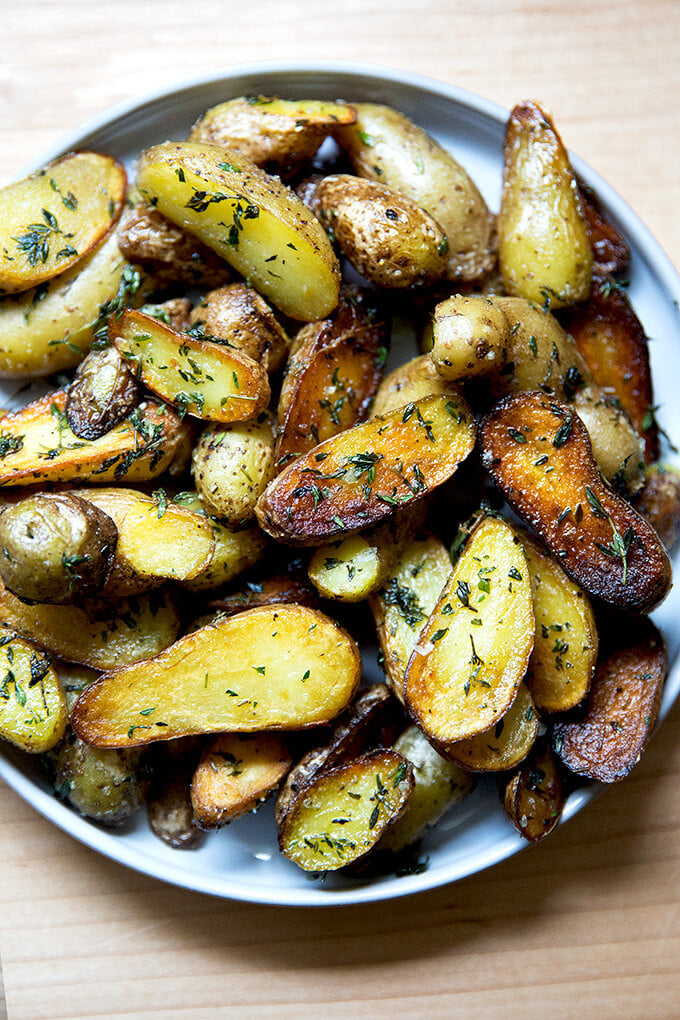
Getting the Most From Your CSA + Two Favorite Potato Recipes

CSA, 9-20-2012

There was a time in my life when subscribing to a CSA had little appeal. I wanted to buy what I wanted to buy when I wanted to buy it. Today, I am happy to have somebody else make the decision for me.

In the past six years, subscriptions to CSAs in eastern Pennsylvania, southern California and northern Virginia have forever transformed how I eat and cook. I have learned to plan meals based on the vegetables I have at hand not the protein. I have learned to appreciate vegetables in their freshest state seasoned with little more than olive oil, salt and pepper. I have eaten more dark leafy greens than I ever imagined.

During this time, too, I have allowed more than one bunch of radishes to shrivel up and rot, a kohlrabi bulb or two to desiccate, and a few bags of okra to mold over. It is painful — shameful — to see these foods spoil. Today, not a morsel of my CSA goes to waste.

Below, I have compiled some things I have learned these past six years that help me utilize my CSA to its fullest potential. Read More

Eggplant Caviar on Grilled Bread

eggplant caviar

Last summer the eggplant chapter of Chez Panisse Vegetables treated me kindly, introducing me to a favorite pasta recipe as well as a most-delicious gratin with tomatoes and onions. And with this eggplant “caviar,” a mash-up of roasted eggplant, fresh parsley, and macerated shallots and garlic, the chapter just seems to keep on giving.

In each of these recipes, eggplant is roasted (as opposed to fried), which requires minimal oil, allowing the eggplant’s sweet flavor to really shine. And after a gentle mashing with a fork, the eggplant’s flesh becomes creamy, a perfect consistency to whip into a spread to spoon over grilled bread. Here, shallots and garlic that have soaked in vinegar add both sweetness and bite without taking over, but I imagine eggplant can hold its own in the presence of even stronger flavors — anchovies, olives, and roasted peppers come to mind.

With eggplant season peaking, now is the time to experiment. And for you eggplant lovers in particular — I know eggplant can be polarizing — get roasting. Read More

Fries with Lemon Salt & Rosemary

fries with lemon salt & rosemary

Lemon sugar revolutionized baking for me. Lemon salt promises to do the same for everything else. Though my use of this flavored salt extends to this single recipe — “straw potatoes” seasoned with lemon salt (thanks to April Bloomfield) and fried with rosemary (thanks to Jamie Oliver) — the possibilities are endless. Salt might just become lemon salt from here on out.

I know deep frying can be intimidating — vats of hot oil are never fun — and somewhat wasteful — even small-batch frying requires a fair amount of oil — and smelly — your kitchen (house?) inevitably will smell of fast-food — but sometimes these sorts of annoyances are worth the trouble. This is one such case. You won’t be disappointed. I promise.

julienned potatoes

lemon zest & salt

mortar & pestle with sea salt and lemon zest

potatoes, rosemary, lemon salt

fries with lemon salt & rosemary

fries with lemon salt & rosemary

A few notes:

• This recipe requires a mandoline — the fine shape of the julienned potato allows them to fry up first time around (as opposed to thick-cut fries, which require a double fry) — and calls for deep frying.
• When deep frying, be very careful. Use a pot with high sides to be safe, and make sure the oil is not filled as far as half-way up the sides — two or three inches should do.
• Fry in small batches: If you add too many potatoes to the hot oil, the oil will bubble over the side of the pan and creep along your stove top, creating a huge mess and posing a serious danger to you and anyone crawling around your floor. Too many potatoes at one time, too, will bring the temperature of the oil down, which will cause the potatoes to take longer to cook also making them soggy in the process.

April Bloomfield’s Rosemary Straw Potatoes with Lemon Salt
Source: Cooking with Jamie

for the lemon salt:
zest of one lemon
4 tablespoons sea salt (I used 3)

sunflower oil (I used a mix of canola and vegetable oil)
1 3/4 lb. potatoes, peeled and julienned* (I used Yukon Gold, and I didn’t peel)
a few sprigs of rosemary

* The potatoes can be julienned in advance — about an hour or so — before they start turning slightly brown. A little brown is OK, but too much brown is probably not a good idea. Storing the potatoes in water will prevent browning, but you also must dry the potatoes very well before you start frying, which is kind of a pain.

1. Make the lemon salt: In a mortar and pestle, bash together the lemon zest and salt until salt is flavored, colored, and fine. Place in a dish. Use whatever you need right away or allow it to dry out for a couple of hours before storing it. (I made my lemon salt a day in advance and stored it in the mortar wrapped in plastic wrap.)

2. Heat 2 to 3 inches of oil in a sturdy, high-sided pan; bring to deep-frying temperature (350°F; to avoid oil catching fire, be sure to maintain its temperature at 350°F). Jamie’s tip: place a potato in the cold oil before you turn the burner on. When the potato rises to the top of the oil and begins to turn golden brown, the oil is ready. Remove the potato piece and start frying in small batches.

3. Pat the julienne strips dry with some paper towels to remove any excess starch. Making sure you’ve got a slotted spoon or spider (which is like a flat colander with a handle) and a big pile of paper towels to one side (I did not use paper towels, but instead transfered the finished fries to a large aluminum bowl, which allows for easy tossing), carefully place some of your potatoes into the pan of oil (don’t overcrowd it) for a couple of minutes (1 to 2) until golden brown and crisp. Cook potatoes in batches until they are all used up. Add the rosemary for the last 30 seconds. (Note: It’s hard to judge when the last 30 seconds will be, but the rosemary can be in the oil for as few as 10 seconds. I basically added the rosemary in at the last few seconds of each batch). Remove the potatoes and rosemary to the paper towels (or a large bowl) to soak up any excess oil; dust with your lemon salt. Serve immediately, perhaps alongside a blue cheese burger as they are at the Spotted Pig.

Orecchiette Carbonara with Asparagus — 2nd Easiest Weeknight Dinner

orecchiette carbonara with asparagus

Hello there. Just a quick midweek post here. Thought I’d share with you all how I’ve made my favorite easy weeknight dinner both more and less involved.

Let me explain. Adding asparagus to pasta carbonara adds about a minute more to your prep time but precludes the need to make any other sort of vegetable side dish — 3/4 of a pound of asparagus, for me at least, is enough roughage for one evening.

So there you have it. Fry some bacon. Sauté some onions. Cook some pasta. Blanch some asparagus. Whisk some eggs. Zest a lemon. Toss it all together, and watch how a no-cream light-on-the-cheese sauce transforms a simple pasta into a creamy-tasting, vegetable-loaded, one-dish dinner. Yum.

orecchiette and eggs

drained asparagus and orecchiette

carbonara in bowl

carbonara in pan

Pasta Carbonara
Source: Everyday Food

Coarse salt and ground pepper
6 slices bacon, cut crosswise into 1-inch pieces
4 leeks* (white and light-green parts only) or spring onions*, halved lengthwise, rinsed well, and thinly sliced
3/4 pound short pasta, such as campanelle or orecchiette
3/4 pound of asparagus, ends trimmed
2 large eggs
1/2 ounce Parmesan, grated (1/4 cup), plus more for serving (optional)
1 tablespoon finely grated lemon zest, plus 1 tablespoon lemon juice
1/2 cup fresh parsley leaves, coarsely chopped (optional — I didn’t use them this time around)

*If you don’t have leeks or onions, any onion will do — finely chop about a half cup or more of whatever onion you have on hand.

1. Set a large pot of salted water to boil. In a large skillet, cook bacon over medium heat, stirring occasionally, until crisp, 8 to 10 minutes. With a slotted spoon, transfer bacon to paper towels to drain. Pour off all but 2 tablespoons fat from skillet. (I did not pour off any fat… it looked too good to discard.) Add leeks, season with salt and pepper, and cook, stirring often, until leeks are golden brown, about 10 minutes.

2. Add pasta to pot and cook according to package instructions. Meanwhile, cut asparagus into 1.5- to 2-inch long pieces. In the last three minutes of the pasta cooking time, drop the asparagus into the pot of water. Reserve 1/4 cup of the pasta cooking liquid.

3. In a large bowl, whisk together eggs, Parmesan, and lemon zest and juice. Whisk 1/4 cup pasta water into egg mixture.

4. Drain pasta and asparagus and immediately add to egg mixture, along with bacon, leeks, and parsley. Season with salt and pepper and stir to combine. Sprinkle with more cheese if desired and serve immediately. Note: If you’re nervous about the egg not cooking, just throw the whole mixture back into a large skillet over medium heat for a minute or two.

orecchiette carbonara with asparagus